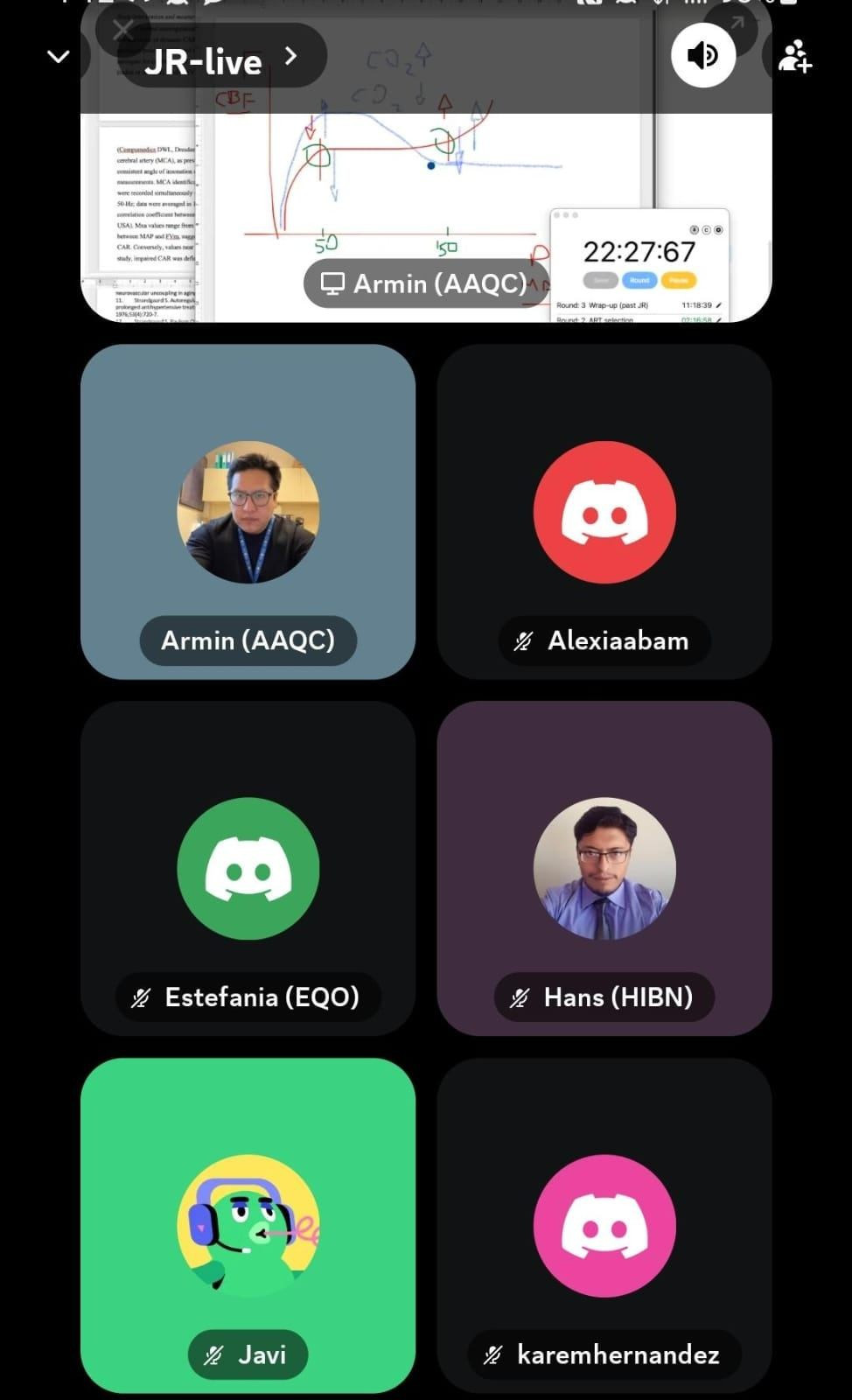
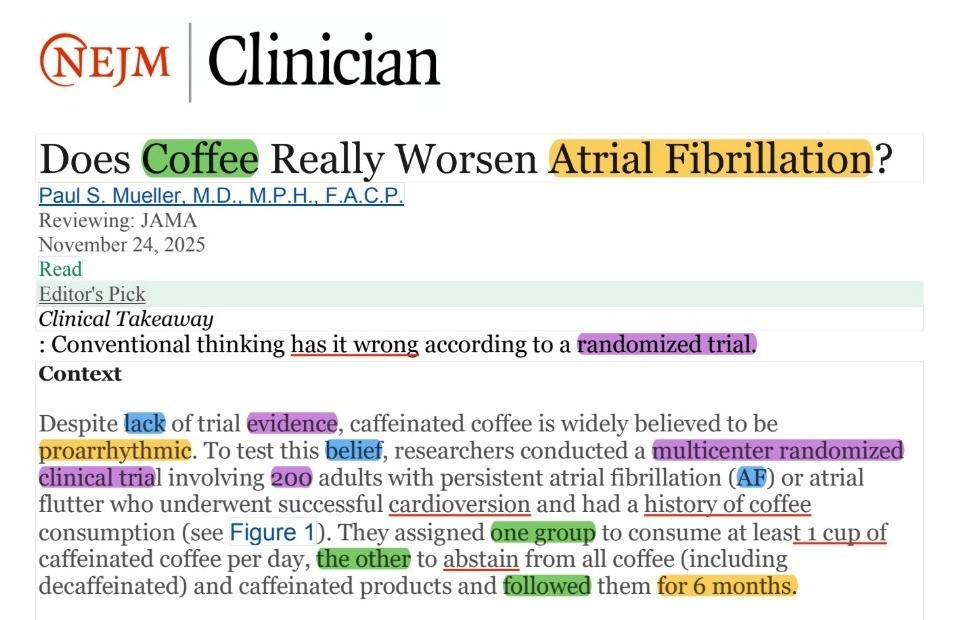
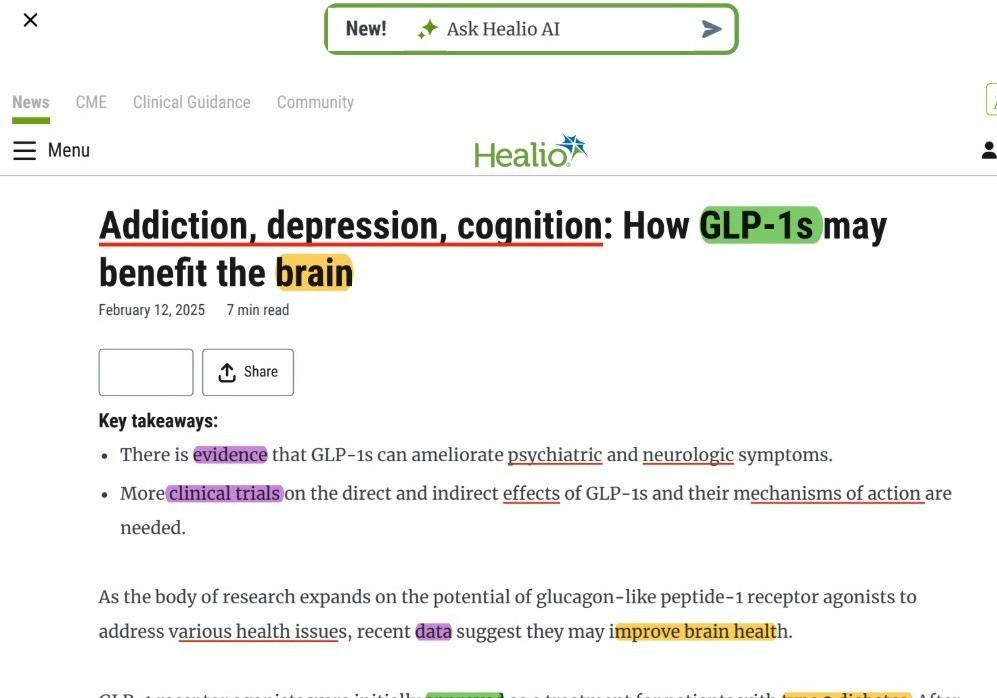
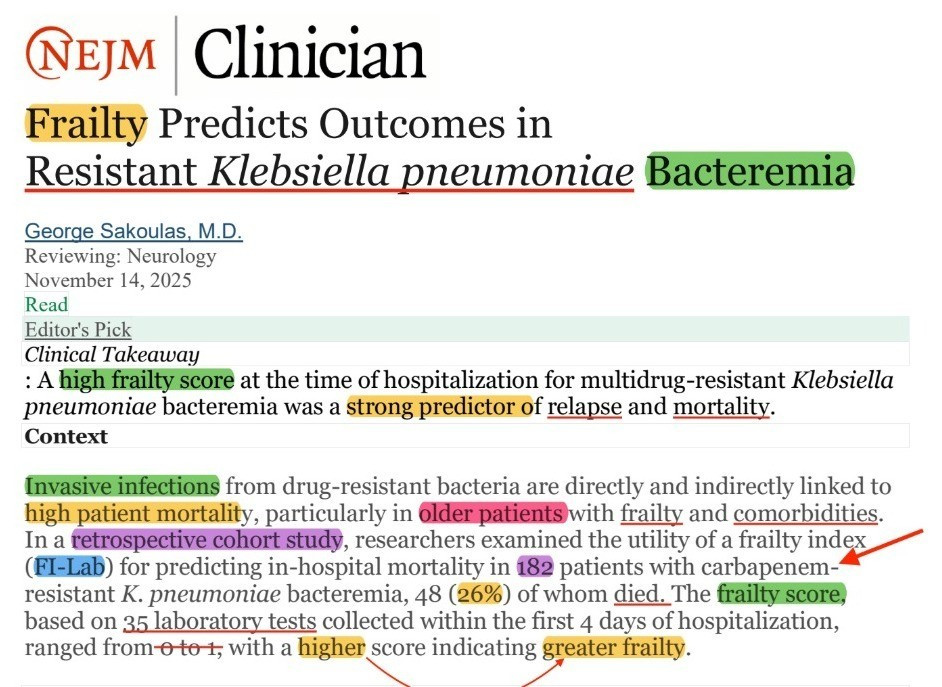
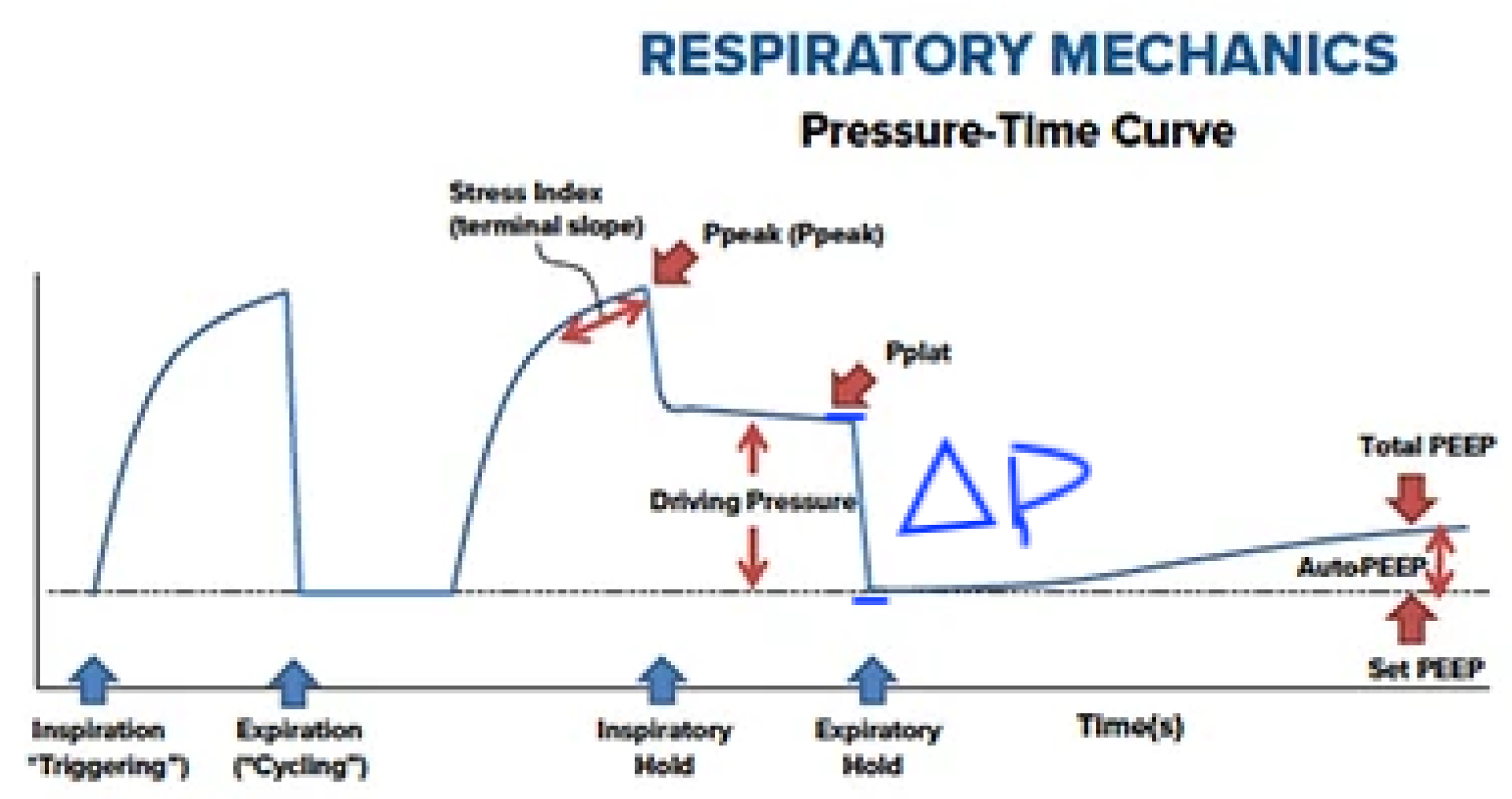
1. A JR is an academic session in which we go through selected article summaries over 60-75 min.
2. It takes place every Monday and Thursday via our JR Discord channel – see calendar.
3. Its purpose is to:
- Understand the main messages from the summarized articles.
- Recall pivotal concepts pertinent to our clinical practice.
- Train clinical reasoning by connecting key concepts to real-life scenarios.
4. The articles are chosen during the session from a curated, labeled, and codified list of remarkable summarized articles.
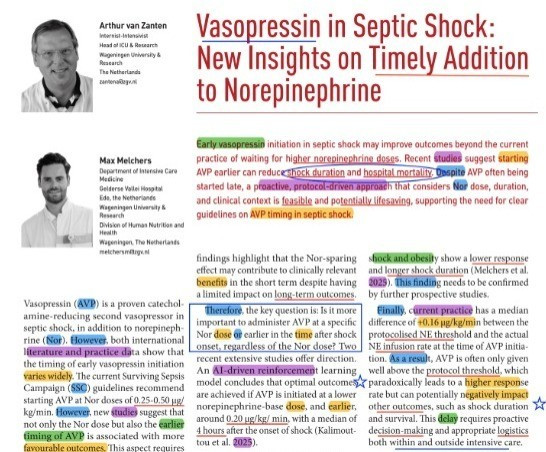
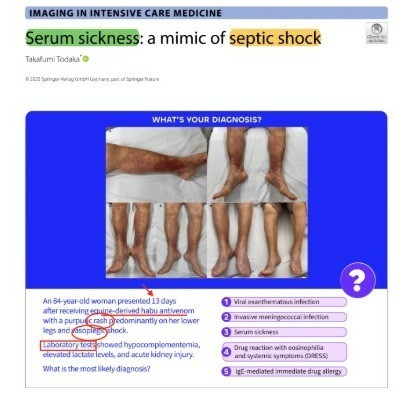
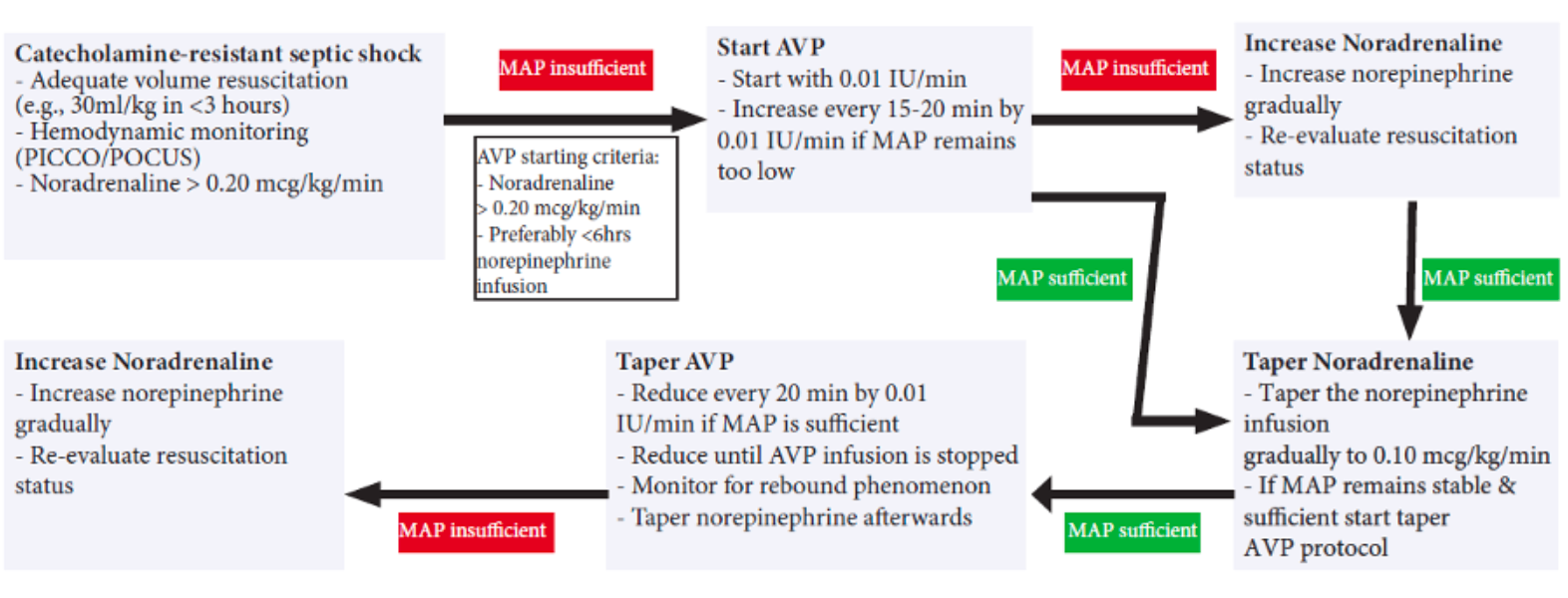
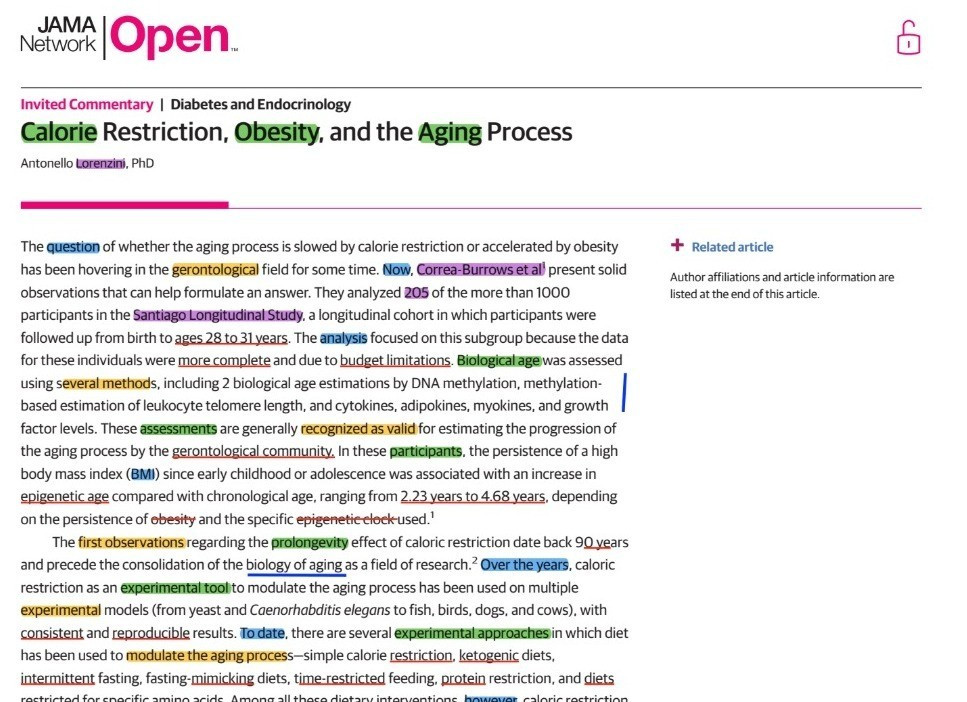
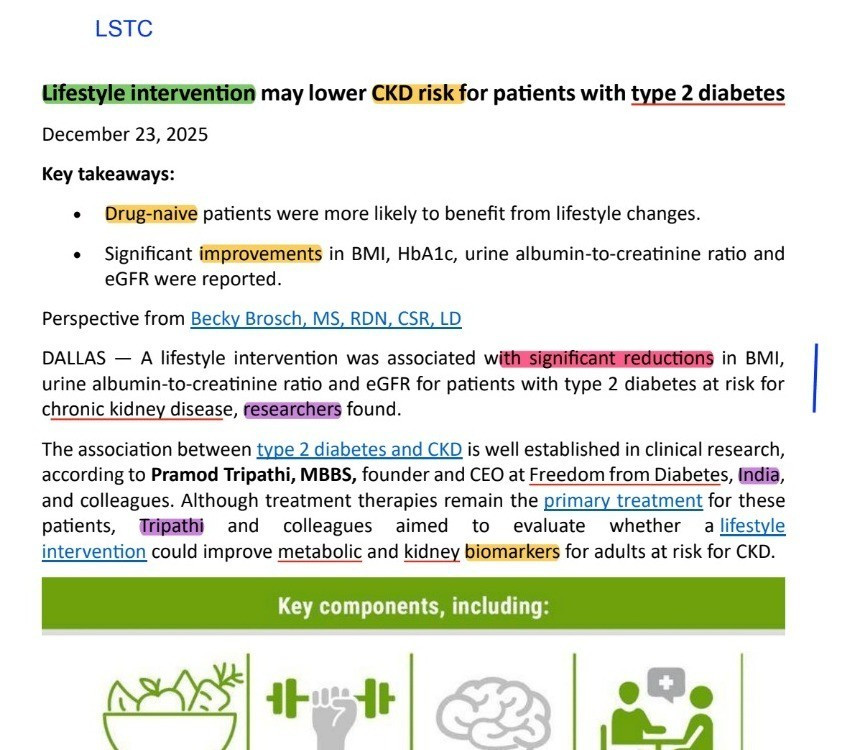
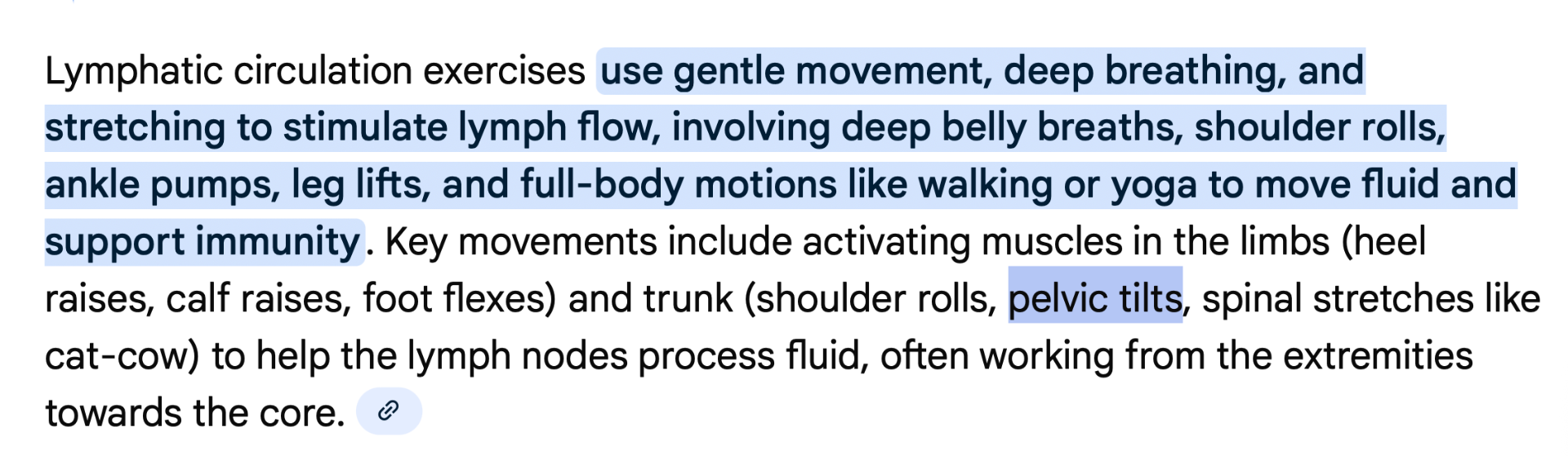
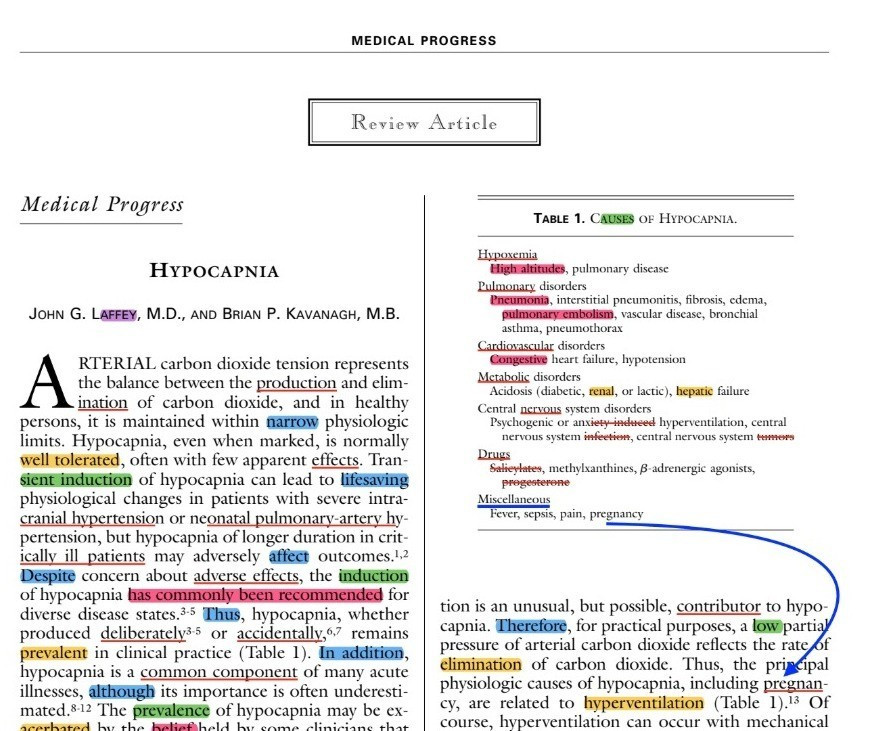
5. We take interactive and pedagogic notes in a shared document, using visual aids, highlighting, underlining, arrows, and conceptual links to connect ideas and facilitate understanding.
6. For each session, we create RECAP key points and publish them on our website.
7. In the following session, we briefly recall the previous JR’s RECAP to reinforce learning through retrieval practice.
⚡️ = cardiac arrest, 🤓 = analysis, 💨 = flow, 📈 = arrhythmia, 🗣 = suggestion(s), 🩸 = blood = hematology, 🪲 = infections, 🧠 = brain, 🫀 = heart, 🫁 = lungs, 🫃🏽 = abdomen = abdominal, ♾️ = kidneys = renal, ◸ = liver = hepatic, ➰ = pressure, 💪🏽 = muscle, ⭕️ = circulation, 🥊 = inflammation, ★ = recommendation(s), ↑ = increase, ↓ = decrease, ↗️ = improve, ↘️ = worsen, 𝗘𝗫 = exclusion, 𝗜𝗡 = inclusion, CIpxs = critically ill patients, DX = diagnosis, h_LOS = Hospital length of stay, icu_LOS = ICU length of stay, inc_ = incident, MA = metaanalysis, mc = multicentric, MM = mortality, MM90 = mortality at 90 days, pOC = primary outcome(s), pxs = patients, RCT = randomized controlled trial, sOC = secondary outcome(s), sr = systematic review, SS = survival, w_ = with, wo_ = without, yo = years old.
𝙄𝙌𝘾 𝙨𝙘𝙤𝙥𝙚 → Y, J, C ➖ T ➕ N ➕ t ➖ P I C O:
2025 NEJMc - Real-World Data on Helicobacter pylori TTO Success (Clin Gastroenterol Hepatol).pdf
Codified by YAPG
Glossary: ATB = antibiotic, HP = Helicobacter pylori, INF = infection, OCAM = PPI (omeprazol, etc.) ➕ clarithro ➕ amoxi ➕ metro, PBMT-14 = PPI, bismuth, metronidazole, and tetracycline, PPI = proton-pump inhibitor
1. 𝙄𝙌𝘾 BS ➩ Y, J, C ➖ T ➕ N ➕ t ➖ P I C O:
2. 𝙄𝙌𝘾 BS 🟰 2025, CG&H, USA ➖ OBS_cohort_real-world ➕ 25k ➕ 2y (2000-2022) ➖ P I C O:
- 🅿: pxs w_HP
- 🅸: comparison of regimens
- 🅲: NA
- 🅾: pOC = efficacy | sOC = frequency of use
3. EVIDENCE.
a. TTO is complicated by 2 problems:
i. ↑ rates of community ATB resistance
ii. No data on resistance patterns for HP
b. GL ➩ 2017, reviewed 2024 ➩ PBMT-14
c. Other regimens are still used
4. METHODS.
- Completed DIETARY INTAKE ASSESSMENTS ➩ SELF-REPORTED (2-4y)
- Levels of intake ➩ subgroups
- 11k w_dementia
5. RESULTS.
a. 17 ≠ regimens for INITIAL INF, the 3 most EFFECTIVE:
i. OCAM ▶︎ 90%
ii. PBMT-14 ▶︎ 88%
iii. OCA ▶︎ 87%
b. Stable EFFICACY of the 3 regimens, through 20y of study.
c. Salvage regimens ➩ LESS EFFECTIVE
i. Particularly, IF duplicated previous regimens.
ii. PBMT-14 = best ▶︎ 69%
d. Prior use of MACROLIDES ⌄ METRONIDAZOL ➩ >3y ▶︎ ↓ SUCESS RATES using clarithromycin ⌄ metronidazole
6. RATIONALE.
a. Amoxi regimens still work well, despite not 1st line TTO option.
b. Caution ➩ study done in Nothern California ➕ applies to other communities 🤔 ❓
c. MAIN LESSION ➩ carefully query pxs (PREVIOUS ATB use) before constructing a regimen.
d. Multiple drug exposure ➩ perform HP susceptibility testing.
⏳ TIME MANAGEMENT
01:03:09
Round: 7 01:45:77 Comments
Round: 6 27:52:42 Wrap-up
Round: 5 17:56:59 Interpretation
Round: 4 04:09:25 Reading + notes
Round: 3 04:28:50 ART selection
Round: 2 01:07:46 Comments
Round: 1 05:49:28 Past JR
Thursday, April 9, 2026 at 18:15:02 in BE
AS, MASP, HIBN, AAQC
2026 NEJMc - Can Coffee and Tea Prevent Dementia (JAMA).pdf
Codified by YAPG
Glossary: HCP = healthcare providers, Q = quartiles
1. 𝙄𝙌𝘾 BS ➩ Y, J, C ➖ T ➕ N ➕ t ➖ P I C O:
2. 𝙄𝙌𝘾 BS 🟰 2026, JAMA, USA ➖ obs, long, 2 cohorts ➕ 130k HCP ➕ 40y ➖ P I C O:
- 🅿: HCP
- 🅸: caffeinated coffee, decaffeinated coffee, tea
- 🅲: NA
- 🅾: pOC = dementia prevention
3. EVIDENCE.
a. Short-term cognitive effect ➩ ↗️ focus + ↗️ alertness
b. OBS ➩ possible long-term benefit ▶︎ ↓r DEMENTIA
4. METHODS.
- Completed DIETARY INTAKE ASSESSMENTS ➩ SELF-REPORTED (2-4y)
- Levels of intake ➩ subgroups
- 11k w_dementia
5. RESULTS.
a. ↓ 2 Q ➩ median caffeinated ☕️ = <1/2 cup daily
b. ↑ 2 Q ➩ median caffeinated ☕️:
i. 2,5-4,5 cups daily ♀
ii. 1 - 2,5 cups daily ♂︎
c. Social ➕ clinical variables ADJUSTED:
i. Caffeinated ☕️ ▶︎ “↑2Q” (↓r dementia) 🆚 “↓2Q”
d. Tea ▶︎ ↓r dementia EVEN w_only 0.07 ☕️ daily.
e. Decaffeinated NOT ASSOCIATED w_↓r dementia.
6. RATIONALE.
a. caution
b. Self-reported intake + residual confounding
c. Caffeine might be NEUROPROTECTIVE.
Monday, April 6, 2026 at 18:10:24 in BE
MG, EQO, AHO, MASP, HIBN, AAQC
⏳ TIME MANAGEMENT
42:16:57
Round: 6 02:09:52 Comments
Round: 5 15:54:71 Wrap-up
Round: 4 09:28:65 Interpretation
Round: 3 03:33:02 Reading + notes
Round: 2 04:28:54 ART selection
Round: 1 06:42:11 Past JR
⏳ TIME MANAGEMENT
28:12:44
Round: 7 00:52:82 Comments
Round: 6 10:34:69 Wrap-up
Round: 5 06:22:19 Interpretation
Round: 4 00:05:81 Interpretation
Round: 3 03:10:71 Reading + notes
Round: 2 02:48:35 ART selection
Round: 1 04:17:84 Past JR
Thursday, April 16, 2026 at 18:10:02 in BE
LH, MASP, AAQC
2026 NEJMc - A New Noninvasive Testing Strategy P. jirovecii pneumonia. (Open Forum Infect Dis)
Codified by 𝙄𝙉𝘼𝘼𝙌𝘾 ᴮᴼ (YAPG)
Glossary: BAL-PCR = bronchoalveolar lavage PCR testing, DX = diagnosis, JPJ = Pneumocystis jirovecii, ↓ supression = immunosupression
1. 𝙄𝙌𝘾 BS ➩ Y, J, C ➖ T ➕ N ➕ t ➖ P I C O:
2. 𝙄𝙌𝘾 BS 🟰 2026, OFID, ? ➖ retro, single center ➕ 114 ➕ ? ➖ P I C O:
- 🅿: pxs w_suspected JPJ + non-HIV ↓ supression
- 🅸: ß-D-glucan, oral wash PCR or both
- 🅲: bronchoalveolar lavage PCR testing
- 🅾: pOC = DX
3. EVIDENCE.
a. PJP DX wo_BAL is challenging due to the limitations of tests of:
i. sputum
ii. serum
b. Combining both NON-INVASIVE to ↗️ DX accuracy ➩ MAKES SENSE
4. METHODS.
a. Oral wash PCR ➩ vigorous gargling of saline for 30s
5. RESULTS.
a. PJP ➩ 15/114 pxs ▶︎ symptoms + imaging + BAL
b. ß-D-glucan:
i. ⊕ 14/15 PJP cases (S 93%)
ii. false ⊕ 13/99 cases wo_PJP.
c. Oral wash PCR:
i. 47 pxs
ii. 11 DX w_PJP
iii. ⊕ 11 PJP cases
iv. false ⊕ 4/36 nonPJP
d. Both:
i. 1. ⊕ 10pxs, all w_PJP
ii. both ⊖ ➩ PJP ruled out
6. RATIONALE.
a. This combination appears DECISIVE
b. Px selection would be an issue ➩ only a subset had “oral wash PCR”
c. Check w_your local laboratory for the tests available.
7. SOURCE: Falcó-Roget A, et al. Combined serum (1,3)-β-D-glucan and oral wash PCR as a noninvasive diagnostic strategy for early detection of Pneumocystis jirovecii pneumonia: An observational retrospective study. Open Forum Infect Dis 2026 Feb; 13:ofag033.
⏳ TIME MANAGEMENT
46:34:63
Round: 7 02:03:28 Comments
Round: 6 23:07:23 Wrap-up
Round: 5 08:38:45 Interpretation
Round: 4 02:57:45 REading + notes
Round: 3 07:39:86 ART selection
Round: 2 00:42:01 Comments
Round: 1 01:26:32 Past JR (+5min)
2025 NEJMc - Phosphatidylethanol Can Inform the DX SLD. (J Hepatol + Lancet GH).pdf
Codified by YAPG
Glossary: -ol = alcohol, AF = atrial fibrillation, ALD = alcohol-associated liver disease, ARDS = acute respiratory distress syndrome, CA = cancer, GE = gastroenterology, JH = Journal of Hepatology, MASLD = metabolic-associated steatotic liver disease, MetALD = metabolic and alcohol-associated liver disease, SLD = steatotic liver disease
1. 𝙄𝙌𝘾 BS ➩ Y, J, C ➖ T ➕ N ➕ t ➖ P I C O:
2. 𝙄𝙌𝘾 BS 🟰 2025, JH, USA ➖ obs, cross-sec ➕ ~400 ➕ ? ➖ P I C O:
- 🅿: overweight/obesity + SLD
- 🅸: phosphatidylethanol
- 🅲: NA
- 🅾: pOC = DX reclassification
3. 𝙄𝙌𝘾 BS 🟰 2025, LANCET GH, DK ➖ Ω pros, cohort ➕ ~2000 ➕ ? ➖ P I C O:
- 🅿: -ol consumption ⌄ metabolic DYSF wo_↑↑↑ -ol use
- 🅸: phosphatidylethanol
- 🅲: NA
- 🅾: pOC = DX reclassification
4. EVIDENCE.
a. MASLD 🆚 ALD depends ➩ ACCURACY ▶︎ self-reported alcohol use
b. Phosphatidylethanol ➩ biomarker of recent -ol use (1-4 weeks)
5. METHODS.
- Correspondence: 🅸 🆚 self-reported -ol intake
- Then assessed to reclassify the DX.
- Steatotic liver disease was categorized (in both studies) on either:
> MASLD
> ALD
> MetALD
- Cutoffs:
> light 🟰 🅸 <25 ng/mL
> moderate 🟰 🅸 25-200 ng/mL
> heavy 🟰 🅸 >200 ng/mL
6. RESULTS.
a. US study ▶︎ MASLD ➩ 95% → 16%:
i. 13% MetALD
ii. 3% ALD
b. DK study ▶︎ MASLD ➩ 70% → 39%:
i. 31% MetALD
ii. 8% ALD
iii. Reclassification w_ALD ⌄ MetALD ➩ rare (<1%)
7. RATIONALE.
a. 🅸 helps:
i. DX + TTO
ii. classifying SLD
b. There is room for error ➩ due to 1-4-week window
c. Never use 🅸 IN ISOLATION ▶︎ ALWAYS w_other factors (careful history)
8. SOURCES.
a. Tavaglione F, et al. Clinical utility of phosphatidylethanol to detect underreported alcohol use and enhance steatotic liver disease subclassification. J Hepatol 2025 Jun
13; [e-pub]. DOI: 10.1016/j.jhep.2025.05.030.
b. Torp N, et al. Phosphatidylethanol and self-reported alcohol intake to subclassify in individuals at risk of steatotic liver disease: An analysis of data from a prospective
cohort study. Lancet Gastroenterol Hepatol 2025 Sep 10; [e-pub]. DOI: 10.1016/S2468-1253(25)00187-6.
Monday, April 13, 2026 at 18:10:09 in BE
MG, AS, AHO, MASP, HIBN, AAQC
Thursday, April 30, 2026 at 18:00:36 in BE
TGA, HIBN, MASP, AAQC
2025 NEJMc - Ceftriaxone for Patients Hospitalized w_Pneumonia, One Gram or Two (J Antimicrob Chemother).pdf
Codified by 𝙄𝙉𝘼𝘼𝙌𝘾 ᴮᴼ (TGA)
Glossary: CAP = community acquired pneumonia
1. 𝙄𝙌𝘾 BS ➩ Y, J, C ➖ T ➕ N ➕ t ➖ P I C O:
2. 𝙄𝙌𝘾 BS 🟰 2025, JAC, JP ➖ retro_cohor ➕ 470k ➕ 7d ➖ P I C O:
- 🅿: CAP
- 🅸: 2g ceftriaxone
- 🅲: 1g ceftriaxone
- 🅾: pOC = MM30
3. EVIDENCE
a. 2019 GL ➩ ATS + IDSA: 1-2g ceftriaxone for H+ pxs w_CAP, wo_precise advice about DOSING
4. METHODS.
- 55% ♂︎
- weight ~50Kg
- 63% 2g = 🅸
- 37% 1g = 🅲
5. RESULTS
a. MM30 = NO DIFFERENCES = 4,5% overall
b. s_CAP 2g ➩ ↓MM30 (17% 🆚 20%)
6. RATIONALE.
a. Cannot be GENERALIZABLE to Western natios (e.g. US)
i. 40% are obese
ii. Few <50Kg
b. George’s hospital ➩ 2g q12h for nonmeningeal INF (≥120Kg)
c. George’s practice ➩ 2g daily in non-obese w_CAP. (regardless of severity)
d. Rather than BASAL GANGLIA, PD is likely a whole-brain action network.
7. SOURCE: Taniguchi J, Aso S, Matsui H, Fushimi K, Yasunaga H. Outcomes of ceftriaxone 2 g versus 1 g daily in hospitalized patients with pneumonia: a nationwide retrospective cohort study. J Antimicrob Chemother. 2025;80(8):2194-2202. doi:10.1093/jac/dkaf189
⏳ TIME MANAGEMENT
33:37:12
Round: 6 00:36:43 Comments
Round: 5 14:34:96 Wrap-up
Round: 4 05:23:99 Interpretation
Round: 3 03:29:88 Reading + notes
Round: 2 05:03:64 ART selectionRound: 1 04:28:20 Past JR
Thursday, April 27, 2026 at 18:00:36 in BE
LH, TGA, MASP, AAQC
2025 CC - Reconsidering the urea-to-creatinine ratio as a signal of muscle catabolism in patients with cirrhosis (Oussalah) (ma).pdf
Codified by 𝙄𝙉𝘼𝘼𝙌𝘾 ᴮᴼ (TGA)
Glossary: AA = aminoacid, ACLD = acute on CLD, AUR = ammonia to urea ratio, CI = critically ill, CLD = chronic liver disease, CREA = creatinine, giBLEED = gastrointestinal bleeding, HRS = hepatorenal syndrome, imp = impaired, ma = matters arising, MECHS = mechanisms, N = nitrogen, R = research = original, sr = systematic review, UCR = urea-to-creatinine ratio, ∑ = so = therefore
1. UREA issues
a. Portal hypertension ➕ hepatocelualr DYS ▶︎ alter N METABOLISM (↓UREAGENESIS efficiency)
b. Ammonia (intestines) → urea (water-soluble, excreted in the urine) ▶︎ ◸
i. Both are indicators of the same pathway
ii. They reflect urea-cycle efficiency
c. Cirrhosis perturbs this pathway:
i. ↑ vascular R ➕ portosystemic shunts 🟰 imp ◸ clearance ➩ ↑ ammonia (systemically)
ii. imp hepatocellular function 🟰 ↓ urea-cycle ➩ ↓ urea (for a given N load)
d. Combined effect ▶︎ ↑ ammonia ➕ ↓ urea
e. CLINICALLY ▶︎ pxs have ↓ ⌄ “normal” UCR ➩ limited ◸ capacity to convert ammonia to urea.
f. AUR > 1,53 mg/g ↔ portal hypertension
i. Complications can modify it.
ii. giBLEED (e.g. variceal) ➩ «↑N load → portal ⭕️» due to 🫃🏽Hb “digestion + reabsorption”
iii. N input ▶︎ ↑ ureagenesis + ↑ urea (not ↔ to 💪🏽 catabolism)
iv. ↑UCR 🟰 exogenous N influx + prerenal dynamics (not AA use ⌄ protein breakdown)
2. INCLUSION of these pxs in pooled 🤓 wo_ stratification = conflating distinct MECHS + limits generalizability.
3. SOLUTIONS
a. Studies should:
i. PROSPECTIVELY stratify
1. cirrhosis
2. portal hypertension
ii. UCR reported
b. ♾️ assessment in cirrhosis ➩ internationally validated approaches OVER CREA-only:
i. cystating C-based equations
ii. measured CREA clearance
c. In NUTRITIONAL 🅸
i. plasma ammonia
ii. plama N balance
iii. Both **distinguish** imp ureageneis **from** protein intake.
iv. In cirrhosis ➩ ↑ UCR + ↑ ammonia = urea-cycle oveload (not excessive catabolism) ▶︎ ∑: «ammonia ↓ strategies» ARE THE PRIORITY (OVER reflective protein restriction)
v. Avoid protein RESTRICTION in ◸ encephalopathy (GL) ➩ 1,2 - 1,5 g/Kg/day to **preserve** N balance + **prevent** sarcopenia
d. giBLEED ⌄ pre♾️ states
i. UCR should prompt TARGETED DX evaluation.
ii. Do not interpret as a STAND-ALONE SIGNAL of 💪🏽 proteolysis
4. SOURCE: Oussalah A, Haghnejad V, Audouy A, et al. Reconsidering the urea-to-creatinine ratio as a signal of muscle catabolism in patients with cirrhosis. Crit Care. 2025;29(1):428. Published 2025 Oct 8. doi:10.1186/s13054-025-05703-1.
⏳ TIME MANAGEMENT
01:20:58
Round: 3 00:36:85 Comments.
Round: 2 49:20:47 Abbreviations update
Round: 1 31:01:59 Past JR recap
2025 CC - Reconsidering the urea-to-creatinine ratio as a signal of muscle catabolism in patients with cirrhosis (Oussalah) (ma).pdf
Codified by 𝙄𝙉𝘼𝘼𝙌𝘾 ᴮᴼ (TGA)
Glossary: AA = aminoacid, ACLD = acute on CLD, AUR = ammonia to urea ratio, CI = critically ill, CLD = chronic liver disease, CREA = creatinine, giBLEED = gastrointestinal bleeding, HRS = hepatorenal syndrome, imp = impaired, ma = matters arising, MECHS = mechanisms, N = nitrogen, R = research = original, sr = systematic review, UCR = urea-to-creatinine ratio, ∑ = so = therefore
1. 𝙄𝙌𝘾 BS ➩ Y, J, C ➖ T ➕ N ➕ t ➖ P I C O:
2. ma ▶︎ 2025, CC, FR ➖ ma ➕ Paulus et al. (MA, UTC CC 2025) ➕ ❓
3. R ▶︎ 2025, CC, NL ➖ srMA ➕ 47/1450 ➕ Sep 3, 2024 ➖ P I C O:
- 🅿: CI pxs
- 🅸: UCR value (at least 1)
- 🅲: NA
- 🅾: pOC = protein catabolism
4. CAUTION. Cirrhosis ➕ portal hypertension:
a. This type of admissions are frequent ➩ 2-4,5% (national cohorts + sr)
b. In ICU ():
i. 20% = cirrhosis ➩ decompensation + ACLD + variceal hemorrhages + HRS
ii. 1/3 = CLD (high-dependency)
c. Both components of UCR are influenced by OTHER processes:
i. ureagenesis
ii. sarcopenia
d. IF this subgroup is taken in the pooled 🤓 → BIAS (inflating⌄attenuating: ↔ ).
5. CREA issues
a. Cirrhosis ➩ 💪🏽 homeostasis
b. Sarcopenia:
i. 14-55% in cirrhosis
ii. ↔: ↓ skeletal 💪🏽
c. CLD MECHS ➩ ↓ CREA (not ↑GFR)
i. imp ◸ creatine synthesis
ii. ↑ fractional tubular secretion
iii. underestimation in ↑bilirrubinemia
iv. Combined effect ➩ ↓shift in CREA for any GFR
v. ∑: ↑UCR in cirrhosis REFLECTS ↓CREA production (not ↑ protein catabolism)
6. UREA issues.
a. Portal hypertension ➕ hepatocelualr DYS ▶︎ alter N METABOLISM (↓UREAGENESIS efficiency)
b. Ammonia (intestines) → urea (water-soluble, excreted in the urine) ▶︎ ◸brain action network.
i. Both are indicators of the same pathway
ii. They reflect urea-cycle efficiency
c. Cirrhosis perturbs this pathway:
i. ↑ vascular R ➕ portosystemic shunts 🟰 imp ◸ clearance ➩ ↑ ammonia (systemically)
ii. imp hepatocellular function 🟰 ↓ urea-cycle ➩ ↓ urea (for a given N load)
d. Combined effect ▶︎ ↑ ammonia ➕ ↓ urea
e. CLINICALLY ▶︎ pxs have ↓ ⌄ “normal” UCR ➩ limited ◸ capacity to convert ammonia to urea.
f. AUR > 1,53 mg/g ↔ portal hypertension
i. Complications can modify it.
ii. giBLEED (e.g. variceal) ➩ «↑N load → portal ⭕️» due to 🫃🏽Hb “digestion + reabsorption”
iii. N input ▶︎ ↑ ureagenesis + ↑ urea (not ↔ to 💪🏽 catabolism)
iv. ↑UCR 🟰 exogenous N influx + prerenal dynamics (not AA use ⌄ protein breakdown)
7. INCLUSION of these pxs in pooled 🤓 wo_ stratification = conflating distinct MECHS + limits generalizability.
8. SOLUTIONS
a. Studies should:
i. PROSPECTIVELY stratify
1. cirrhosis
2. portal hypertension
ii. UCR reported
b. ♾️ assessment in cirrhosis ➩ internationally validated approaches OVER CREA-only:
i. cystating C-based equations
ii. measured CREA clearance
c. In NUTRITIONAL 🅸
i. plasma ammonia
ii. plama N balance
iii. Both **distinguish** imp ureageneis **from** protein intake.
iv. In cirrhosis ➩ ↑ UCR + ↑ ammonia = urea-cycle oveload (not excessive catabolism) ▶︎ ∑: «ammonia ↓ strategies» ARE THE PRIORITY (OVER reflective protein restriction)
v. Avoid protein RESTRICTION in ◸ encephalopathy (GL) ➩ 1,2 - 1,5 g/Kg/day to preserve N balance + prevent sarcopenia
d. giBLEED ⌄ pre♾️ states
i. UCR should prompt TARGETED DX evaluation.
ii. Do not interpret as a STAND-ALONE SIGNAL of 💪🏽 proteolysis
9. SOURCE: Oussalah A, Haghnejad V, Audouy A, et al. Reconsidering the urea-to-creatinine ratio as a signal of muscle catabolism in patients with cirrhosis. Crit Care. 2025;29(1):428. Published 2025 Oct 8. doi:10.1186/s13054-025-05703-1.
Thursday, April 23, 2026 at 18:10:36 in BE
LH, TGA, MASP, YAPG,HIBN, AAQC
⏳ TIME MANAGEMENT
01:20:58
Round: 3 00:36:85 Comments.
Round: 2 49:20:47 Abbreviations updateRound: 1 31:01:59 Past JR recap
Monday, April 20, 2026 at 18:05:06 in BE
AHO, TGA, MASP, YAPG, AAQC
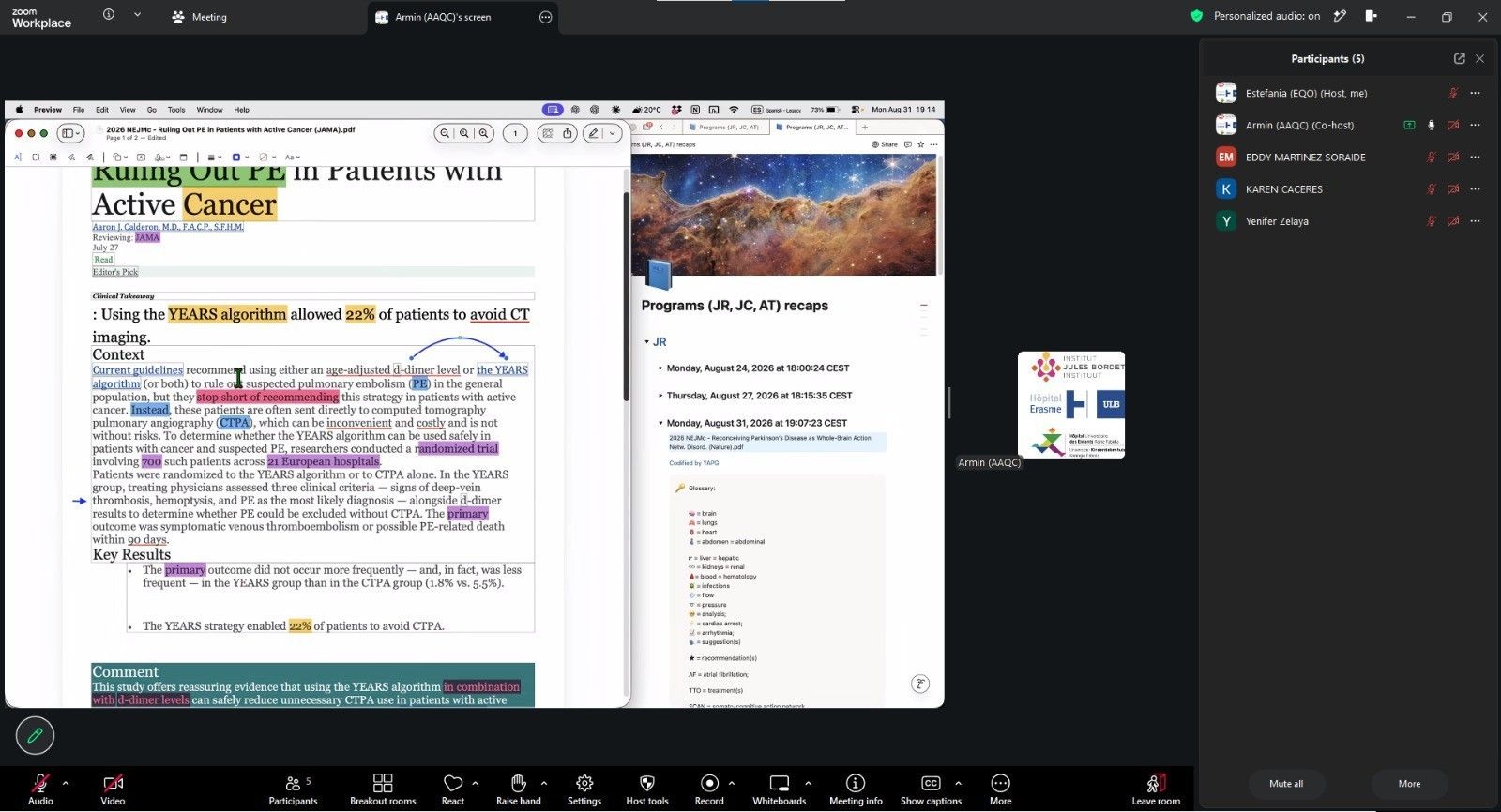
2026 NEJMc - Reconceiving Parkinson’s Disease as Whole-Brain Action Netw. Disord. (Nature).pdf
Codified by YAPG
Glossary: somato-cognitive action network, PD = Parkinson’s disease, TTO = treatment(s), US = ultrasound, 🧠 = brain
1. 𝙄𝙌𝘾 BS ➩ Y, J, C ➖ T ➕ N ➕ t ➖ P I C O:
2. 𝙄𝙌𝘾 BS 🟰 2026, NATURE, ❓ ➖ obs ➕ 863 ➕ ❓ ➖ P I C O:
- 🅿: PD pxs
- 🅸: imaging: SCAN
- 🅲: NA
- 🅾: pOC = impairment
3. EVIDENCE.
a. Dopaminergic degeneration: basal ganglia ➩ motor ↔ nonmotor PATHWAYS
b. Explains TREMOR ➕ RIGIDITY
c. Cognitive ➕ motivational ➕ autonomic FEATURES ➩ NOT EXPLAINED
d. Is a broader, integrated 🧠 network the problem?
4. METHODS.
- SCAN 🟰 recently described. Network linking the control of:
> movement
> cognition
> motivation
> autonomic
5. RESULTS.
a. PD ▶︎ ↑ connectivity:
i. SCAN ↔ subcortical structures
ii. ↑ ↑ ↑ hyperconnectivity ≈ WORSE motor ➕ cognitive impairment.
b. Effective TTOs, ALL ↓ SCAN:
i. levodopa
ii. Deep brain stimulation
iii. transcranial magnetic stimulation
iv. focused US
c. ↑ normalization of CONNECTIVITY ≈ ↑ clinical ↗️
d. Targeting SCAN ▶︎ ↗️ TTO EFFECTIVENESS for:
i. transcranial magnetic stimulation
ii. focused US
6. RATIONALE.
a. SCAN might underlie PD
b. Current TTO might MODULATE this network.
c. Rather than BASAL GANGLIA, PD is likely a whole-brain action network.
d. SCAN dysfunction 🟰 core circuit abnormality.
e. If validated, it will influence:
i. the neuromodulation
ii. how we think about IMAGING BIOMARKERS ➩ personalized therapy.
7. SOURCE: Ren J, et al. Parkinson’s disease as a somato-cognitive action network disorder.Nature 2026 Feb 4; [e-pub]. DOI: 10.1038/s41586-025-10059-1.
⏳ TIME MANAGEMENT
01:40:51
Round: 13 27:59:21 Comments
Round: 12 16:49:89 Wrap-up 2
Round: 11 00:42:85 Wrap-up 1
Round: 10 06:03:38 Interpretation
Round: 9 02:26:33 Reading + notes
Round: 8 02:16:18 Comments
Round: 7 18:14:10 Wrap-up
Round: 6 09:51:46 Interpretation
Round: 5 02:28:02 Reading + notes
Round: 4 04:17:67 ART Selection
Round: 3 00:32:04 Comments
Round: 2 08:37:45 Last JR
Round: 1 00:33:00 Opening
2026 CC - Phenotype, subphenotype, and endotype in S• and ARDS, a new layer of heterogeneity (Zhao) (corr).pdf
Codified by 𝙄𝙉𝘼𝘼𝙌𝘾 ᴮᴼ (TGA)
Glossary: I2 = heterogeneity, PD = Parkinson’s disease, POV = point of view, PSE = phenotype, subphenotype, endotype, S• = sepsis, SCAN = somato-cognitive action network, SOC = standard of care, TTO = treatment(s), US = ultrasound
1. 𝙄𝙌𝘾 BS ➩ Y, J, C ➖ T ➕ N ➕ t ➖ P I C O:
2. 𝙄𝙌𝘾 BS 🟰 2026, CC, CH ➖ corr ➕ NA ➕ NA ➖ P I C O:
- 🅿: CIpxs
- 🅸: USG → lower limb muscle
- 🅲: NA
- 🅾: pOC = utility
3. ARDS = syndrome ➩ masks BIOLOGICAL I2 🟰 primary obstacle to TTO
4. Studies identify PSE ➩ but THE EFFORTS create new layer of I2
a. IMPEDE rather than enable discarding the “syndrome” label.
b. despite inventive cogitation + methodological sophistication
5. PURPOSE
a. Deconstruct heterogeneous clinical syndromes ➩ biological homogeneous + clinical TTO subgroups
b. Facilitate PRECISION medical➕ optimize INDIVDUAL TTO
6. CLASSIFICATIONS
a. Derive from multiple analytical approaches:
i. high-dimensional clinical variables
ii. multi-omics data ➩ integrated analysis of multiple molecular layers (e.g., genomics, transcriptomics, proteomics, metabolomics) to obtain a holistic view of biological systems.
iii. AI-driven deep learning
b. Evidence shows INCOMPLETE CONCORDANCE → loosely correlate biological phenomena.
c. Question: which type or subtype, if any, represents “true” disease biology?
d. The risk of multiplicity classification ➩ fragmented atlas INSTEAD OF unified map of S• + ARDS pathobiology.
7. ACHIEVEMENT
a. RCT ➩ hidden TTO effect obscured in unselected populations.
b. They are retrospective + hypothesis-generating ➩ ∑ yet to be incorporated in SOC. (intellectually fascinating + mechanistically informative)
c. Solution ➩ to validate prospectively
d. Assumption ➩ the subgroups reflect DISTINCT EXPRESSIONS of a single underlying disease.
e. Sth more unsettling ➩ S• ➕ ARDS 🟰 represents a multitude of distinct diseases ❓ ▶︎ “ENDEAVOR built on shifting sands”.
i. Unique utility → ID subgroups that responds to a given therapy.
ii. DOES NOT RESOLVE:
1. definition problem
2. question if S• is a coherent disease
8. POV
a. PSE ➩ implies complexity of ▶︎ pxs ➕ methodology & taxonomy
b. Instead of DESCRIPTIVE, go for CAUSAL investigation
c. Statistical artifacts 🆚 biological realities.
9. SOURCE: Z[hao, L., Zhao, C., Wang, M. *et al.* Phenotype, subphenotype, and endotype in sepsis and ARDS: a new layer of heterogeneity?. Crit Care 30, 173 (2026). https://doi.org/10.1186/s13054-026-06022-9
Thursday, May 14, 2026 at 18:21:36 in BE
TGA, RCH, SLDC, HIBN, AAQC
⏳ TIME MANAGEMENT
01:17:25
Round: 7 02:51:40 Comments
Round: 6 27:58:20 Recap
Round: 5 30:54:32 Interpretation
Round: 4 03:56:45 Reading + notes
Round: 3 06:15:83 ART selection
Round: 2 00:34:26 Comments
Round: 1 04:55:17 Past JR
⏳ TIME MANAGEMENT
58:48:87
Round: 6 00:43:28 Comments
Round: 5 25:52:54 Wrap-up
Round: 4 15:16:22 Interpretation
Round: 3 04:16:43 Reading + notes
Round: 2 07:13:41 ART selection
Round: 1 05:26:98 Past JR
2026 CC - Ultrasound assessment of muscle atrophy and its association with functional OC in CIpxs (Lin) (srMA).pdf
Codified by 𝙄𝙉𝘼𝘼𝙌𝘾 ᴮᴼ (TGA)
Glossary: AF = atrial fibrillation, CI pxs = critically ill patients, CT = computed tomography, DEXA = dual-energy X-ray absorptiometry, ICU-AW = ICU-acquired weakness, MRI = magnetic resonance imaging, USG = ultrasound, ≠ = differences
1. 𝙄𝙌𝘾 BS ➩ Y, J, C ➖ T ➕ N ➕ t ➖ P I C O:
2. 𝙄𝙌𝘾 BS 🟰 2026, CC, TW ➖ srMA ➕ 69 ➕ -Oct 11, 2025 ➖ P I C O:
- 🅿: CIpxs
- 🅸: USG → lower limb muscle
- 🅲: NA
- 🅾: pOC = muscle atrophy monitoring
3. EVIDENCE
a. CIpxs → skeletal muscle wasting:
i. immobility
ii. systemic inflammation
b. Accuracy 🆚 impracticality ➩ cost + radiation + logistics
i. CT
ii. MRI
iii. DEXA
c. USG ➩ bedside + radiation-free + repeatable ➕ assess:
i. quantitative → cross-sectional area + muscle tickness
ii. qualitative → echointensity + pennation angle
4. RESULTS.
a. D7 of ICU admission
i. CROSS-SECTIONAL AREA:
1. Rectus femoris 🟰 ↓16%
2. Quadriceps 🟰 ↓ 11%
ii.. ECHOINTENSITY ↑
iii. PENNATION ANGLE ↓
iv. ∑ ▶︎ compositional + architectural **deterioration.**
v. Heterogeneity is ↑ ↑ ➩ reflects ≠ in px characteristics
1. pxs characteristics
2. anatomical landmarks
3. USG technical factors
vi. Limited data ▶︎ USG changes ↔ ICU-AW
b. D1-3 of ICU admission (excluding an outlier)
i. CROSS-SECTIONAL AREA:
1. Rectus femoris 🟰 GREATER ↓ ↓ ↓ in ICU-AW
2. Compared to non ICU-AW
5. CONCLUSIONS.
a. USG detects: early, rapid muscle wasting → concurrent QUALITY degradation.
b. Very low CERTAINTY OF EVIDENCE:
i. Heterogeneity
ii. Methodological limitations
iii. BOTH ➩ hinder clinical translation.
c. Needs clarification of the USG potential clinical utility.
.
6. SOURCE: Lin CC, Lin YJ, Chen CT, Chou HM, Hsu WC. Ultrasound assessment of muscle atrophy and its association with functional outcomes in critically ill patients: a systematic review and meta-analysis. Crit Care. Published online March 31, 2026. doi:10.1186/s13054-025-05825-6
Monday, May 11, 2026 at 18:28:41 in BE
TGA, BAR, RCH, SLDC, ASCA, AAQC
2026 ICM - Temperature control in ABI (Lavinio) [r].pdf
Codified by 𝙄𝙉𝘼𝘼𝙌𝘾 ᴮᴼ
Glossary: ★ = recommendation(s), GL = guidelines, icHTA = intracranial hypertension, ICP = intracranial pressure, AvBI = acute vascular brain injury, ABI = acute brain injury, CA = cardiac arrest, ↓T = hypothermia, fOC = functional outcome , SOC = standard of care
1. 𝙄𝙌𝘾 BS ➩ Y, J, C ➖ T ➕ N ➕ t ➖ P I C O:
2.𝙄𝙌𝘾 BS 🟰 2026, ICM, UK ➖ r ➕ NA ➕ NA ➖ P I C O:
🅿: Tº control in ABI
3. EVIDENCE:
a. Temperature:
i. Key determinant of 🧠 VULNERABILITY
ii. Physiological variable
b. Continous monitoring + active control ➩ ICU
c. Role evolution ➩ hypothermia → early recognition → normothermia.
d. Review ➩ physiological rationale ➕ clinical evidence ➕ contemporary practice
4. METHODS.
a. Synthesised evidence:
- RCTs
- OBS
- Consensus
- Monitoring + implementation approaches
5. RESULTS.
a. General.
i. Fever ↔ WORSE 🧠 OC
b. TBI. ↓T:
i. ↓ICP but **does not** ↗️ fOC (when used prophylactically)
ii. Reserved for refractory icHTA
iii. NEJM 1997 ➕ NABIS:H I (NEJM 2001) ➕ NABIS:H II (LANCETn 2011) ➕ EUROTHERM3235 (NEJM 2015) ➕ POLAR-RCT (JAMA 2018)
iv. Fixed 33ºC (1997-2011) → interval 32/33ºC - 35ºC (2015-2018)
v. EUROTHERM3235 → comparator SOC
vi. All RCTs
vii. POLAR → ≥72h → 7d (if ICP ↑)
c. AvBI (neutral trial + feasibility constraints)
i. Early detection
ii. Treat fever rather than ↓T
iii. 3 RCTs → ILUSTRATES: feasibility + safety challenges ➖ barriers in awake pxs
iv. 1 OBS → ↑severity + ↑infarct size + ↑ MM + ↘️ OC
v. LANCET 1996 ➕ ICTuS 2 (STROKE 2016) ➕ EuroHYP-1 (EUR STROKE 2019) ➕ INTREPID (JAMA 2024)'
d. Post CA. Contemporary GL ★ protocolised T control w_target:
i. 32ºC - 37,5ºC (≥36h)
ii. active prevention of fever (not mandatory ↓T)
6. EVIDENCE
a. Use core T probes.
7. SOURCE: Lavinio, A., Busl, K.M., Coles, J.P. et al. Temperature control in acute brain injury. *Intensive Care Med* (2026). https://doi.org/10.1007/s00134-026-08367-9
⏳ TIME MANAGEMENT
01:17:55
Round: 9 02:44:16 Comments
Round: 8 16:39:23 Table + RECAP
Round: 7 05:44:46 RECAP
Round: 6 15:57:97 Images
Round: 5 15:47:41 Key-points
Round: 4 06:20:65 Interpretation (abstract)
Round: 3 04:12:62 Reading + notes
Round: 2 06:16:95 ART selection
Round: 1 04:11:81 Past JR
Thursday, May 21, 2026 at 18:33:07 in BE
RCH, AHO,TGA, DEPZ, ASCA, SLDC, HIBN, AAQC
2026 NEJM - Side effects of Radiotherapy (NEJM)
Codified by 𝙄𝙉𝘼𝘼𝙌𝘾 ᴮᴼ
Glossary: antiDiarr = antidiarrheals, CAD = coronary artery disease, H2B = H2 blockers, PPI = protom pump inhibitors, SE = side effects, ↓ Hb = anemia, ↓ N = neutropenia, ↓ PLT = thrombocytopenia
1. 𝙄𝙌𝘾 BS ➩ Y, J, C ➖ T ➕ N ➕ t ➖ P I C O:
2. 𝙄𝙌𝘾 BS 🟰 2026, NEJM, USA ➖ r ➕ NA ➕ NA ➖ P I C O:
🅿: onco pxs w_radiotherapy
3. EVIDENCE.
a. Radiotherapy is a KEY TTO ➩ cancers
b. INNOVATIONS ➩ imaging + radiation delivery ➩ ↗️ :
4. REVIEW. Side effect from radiation TTOs:
a. Acute SE
i. 👅 Mucosal.
1. MUCOSITIS ⌄ ESOPHAGITIS ▶︎ top_Anest ➕ nystatin ➕ analgesics ➕ sucralfate ➕ H2B ➕ PPI ➕ nutriSupport
iii.🫃 Gastric
1. GASTRITIS ▶︎ H2B ➕ PPI ➕ sucralfate ➕ antiemetics
iv. 🦠 Intestinal
1. ENTERITIS ▶︎ antiDiarr ➕ low-residue diet ➕ somatostatin
2. Acute PROCTITIS ▶︎ symp_mm ➕ antiDiarr
iv. 🩸 Hematologic
1. ↓N ▶︎ G-CSF
2. ↓Hb ▶︎ erythropoietin ➕ transfusion
3. ↓PLT ▶︎ transfusion
v. 🚽 Urinary
1. OBSTRUCTIVE ▶︎ ♾️ blocker ➕ NSAIDs
2. IRRITATITVE ▶︎ antiMusc ➕ NSAID ➕ phenazopyridine
vi. 🩹 Cutaneous
1. DERMATITIS ▶︎ ↓friction ➕ ↑ barriers (hydrogel, silicone) ➕ topSteroids ➕ topMoisturizers ➕ silver dressing ➕ silver sulfadiazine
b. Subacute ⌄ late SE
i. 🧠 Central nervous system
1. NEUROCOGNITIVE defects ▶︎ neurostimulants ➕ memantine ➕ donepezil
2. NECROSIS ▶︎ steroids ➕ bevacizumab ➕ resection
3. CATARACTS ▶︎ surgical removal
4. OPTICAL neuropathy ▶︎ bevacizumab
ii. 💧 Salivary
1. XEROSTOMIA ▶︎ saliva substitutes ➕ parasympathomimetic drugs ➕ hyperbaric O2 therapy
iii. 🔽 Esophageal
1. STRICTURE ▶︎ dilation ➕ H2B ➕ PPI
iv. 🫁 Pulmonary
1. PNEUMONITIS ▶︎ steroids ➕ O2
2. FIBROSIS ▶︎ O2
v. ❤️ Cardiac
1. PERICARDITIS ▶︎ NSAIDs
2. VALVULAR disease ➕ CAD ▶︎ med_mm ➕ surgery
3. ARRHYTHMIAS ▶︎ HR control ➕ pacemaker
vi. 🦠 Intestinal
1. CHRONIC enteritis ▶︎ antiDiarr ➕ bile-acid sequestrants
2. CHRONIC proctitis ▶︎ sucralfate ⌄ formalin enemas ➕ argon plasma coagulation ➕ hyperbaric oxygen therapy
3. FISTULA ▶︎ surgical repair
vii. 🚽 Urinary
1. IRRITATIVE ▶︎ antiMusc ➕ NSAIDs ➕ phenazopyridine
2. HEMORRHAGIC cystitis ▶︎ irrigation ➕ laser treatment ➕ alum ➕ hyperbaric O2 therapy ➕ formalin ➕ diversion
3. STRICTURE ▶︎ dilation ➕ surgical repair
viii. ⚥ Sexual
1. ERECTILE dysfunction ▶︎ PDE5 ⊖ ➕ mechanical aids ➕ other pharmacologic aids
2. VAGINAL stenosis ▶︎ dilators ➕ lubricants ➕ topEstrogens
ix. 💪 Muscular or cutaneous 🩹
1. ATROPHY ⌄ FIBROSIS ▶︎ physical therapy ➕ botulinum toxin ➕ pentoxifylline ➕ tocopherol
2. LYMPHEDEMA ▶︎ compression
3. NECROSIS ▶︎ antibiotics ➕ débridement ➕ hyperbaric O2 therapy
5. RATIONALE.
a. Despite all TTOs, radiation carries its own risks.
Monday, May 18, 2026 at 18:30:33 in BE
LH, TGA, RCH, BAR, DEPZ, ASCA, HIBN, AAQC
⏳ TIME MANAGEMENT
01:01:41
Round: 7 01:07:26 Comments
Round: 6 23:43:83 Recap
Round: 5 14:46:79 Interpretation
Round: 4 02:44:07 REad + notes
Round: 3 10:14:52 ART methodology
Round: 2 03:37:07 ART selection
Round: 1 05:27:60 Past JR
2026 NEJMc - Reconceiving Parkinson’s Disease as Whole-Brain Action Netw. Disord. (Nature).pdf
Codified by YAPG
Glossary: ↓💨 = hypoperfusion, µCIR = microcirculation, ompSOFA = obstetrically modified quick SOFA, RRT = rapid response teams, SSØ = septic shock, Sx = surgery, UVA = universal vital assessment, 🩸 hh = hemorrhage
↓💨 = hypoperfusion
1.𝙄𝙌𝘾 BS ➩ Y, J, C ➖ T ➕ N ➕ t ➖ P I C O:
2. 𝙄𝙌𝘾 BS 🟰 2025, CC, MX ➖ obs, pros ➕ 1448 (110 admitted ICU) ➕ Nov 2021 - Mar 2024 ➖ P I C O:
- 🅿: obstetric pxs (3rd trimester + early postpartum = w_RRT activated)
- 🅸: CRT evaluation as ICU admission criterion
- 🅲: NA
- 🅾: pOC = ICU admission
3. EVIDENCE:
a. Maternal MM ➩ global public health priority (developing world)
b. Detection + treatment (physiological derangements) ➩ PROMPT
c. Maternal & neonatal OC = 🩸hh ➕ HTA ➕ S•
d. RRT ➩ rapid response teams → OC
e. Monitoring tools → for early ID + supportive TTO + optimization resources.
f. Shock + other conditions ➩ CRT is used (marker of tissue ↓💨 )
g. CRT ➩ cost-free ➕ universally available ➕ bedside
4. METHODS.
5. RESULTS
a. Pregnant = 62% ➕ postpartum = 39%
b. 7,6% admitted to the ICU.
c. Causes
i. HTA
ii. 🩸 hh
iii. SSØ
d. UNIVARIATE
i. diastolic HTA (RR 2,7. p=0.0001) AUROC 0,58. p=0.003
ii. severe bleeding > 1000mL (RR 11. p=0.0001) AUROC 0,56. p=0.03
iii. CRT > 3,5s (RR 14,2. p=0.0001) AUROC 0,72. p=0.001
e. MULTIVARIATE
i. severe bleeding > 1000mL
ii. CRT > 3,5s
f. Better RR with CRT.
6. RATIONALE
a. Pregnancy is related to microcirculation derangements.
b. Sublingual alterations shown.
c. Strong prolonged CRT ↔ sublingual µCIR ➩ SSØ
d. Current TTO might MODULATE this network.
e. Rather than BASAL GANGLIA, PD is likely a whole-brain action network.
f. SCAN dysfunction 🟰 core circuit abnormality.
g. If validated, it will influence:
i. the neuromodulation
ii. how we think about IMAGING BIOMARKERS ➩ personalizad therapy.
h. Future studies are warranted (utility + applications)
7. SOURCE: Monares Zepeda et al. Critical Care https://doi.org/10.1186/s13054-025-05404-9 (2025) 29:231
Thursday, May 28, 2026 at 18:20:27 in BE
RCH, TGA, BAR, SLDC, MASP, HIBN, AAQC
⏳ TIME MANAGEMENT
01:25:51
Round: 6 02:13:52 Comments
Round: 5 25:07:88 RECAP
Round: 4 36:11:17 Interpretation
Round: 3 09:30:58 Reading + notes
Round: 2 05:32:34 JR selection
Round: 1 07:16:23 Past JR
2025 NEJMc - Updates in Hypertension Management (H).pdf
Codified by YAPG
Glossary: LT = levothyroxine, SH = subclinical hypothyroidism, ↑T = hyperthyroidism
1. 𝙄𝙌𝘾 BS ➩ Y, J, C ➖ T ➕ N ➕ t ➖ P I C O:
2 𝙄𝙌𝘾 BS 🟰 2025, HYPERTENSION, USA ➖ GL ➕ NA ➕ NA ➖ P I C O:
3. EVIDENCE:
a. New evidence published by AHA, ACC/ AANP/AAPA/ABC/ACCP /ACPM/AGS /AMA/ASPC/NMA/PCNA/SGIM
b. 2017 GL → ↑HTA = >130 / >80
c. Past GL → ↑HTA = >140 / >90 ➕ target 130/80 only in hrPxs
d. Evidence supports the case of lower BP targets.
e. Previously → BP CONTROL only if CVr>10%.
f. 15 million adults = ↑r for HF
g. Risk categories (10y 🫀r ➖ PREVENT calculator):
i. low (<10%),
ii. intermediate (10–19.9%),
iii. high (≥20%)4. METHODS.
4. METHODS
5. RESULTS.
a. Early + aggresive TTO is promoted.
i. nearly all pxs w_HTA
ii. target BP <130/<80
iii. encouragement → achieve SBP <120
b. Risk estimation:
i. new PREVENT risk calculator
ii. Low BP TARGETS, ★:
1. strong = 10y 🫀r ≥7,5%
2. weak = 10y 🫀r <7,5%
c. Measures
i. Home ✔︎ 🆚 office ✖︎
ii. Clinicians should give > ⓘ of HOW TO...
iii. ▶︎ Survey in HTA pxs (self-monitoring):
1. Less than 1/2 ➩ receive ⓘ from their clinicians
2. Most ➩ did NOT follow BEST PRACTICES
d. Aldosterone + renin levels
i. Used for primary aldosteronism
1. resistant HTA
2. ↓K
3. sleep apnea
4. early S† (<40yo)
i. ▶︎ Endocrine Society GL 2025 → screening in all pxs w_HTA
ii. ▶︎ Both GL → test (can and should) both biomarkers
1. d_HTA TTO
2. except w_mineralocorticoid-receptor antagonists.
3. nuanced guidance (Endocrine Society GL) on MEDS
a. to hold
b. how long
6. RATIONALE.
1. Target BP <130/<80 ➩ norm rather than exception.
2. BEtter home than office.
3. Benefits vary w_risk (PREVENT calculator)
7. SOURCE: Jones DW, et al. 2025 AHA/ACC/AANP/AAPA/ABC/ACCP/ACPM/AGS/AMA/ASPC/NMA/PCNA/SGIM guideline for the prevention, detection, evaluation and management of high blood pressure in adults: A report of the American College of Cardiology/American Heart Association Joint Committee on Clinical Practice Guidelines. Hypertension 2025 Oct; 82:e212 10.1161/HYP.0000000000000249. PubMed
Thursday, June 4, 2026 at 18:05:17 in BE
TGA, KEPA, KYEC, JCAS, SLDC, AAQC
2026 NEJMc - Deprescribing Levothyroxine in Older Adults (JAMA).pdf
Codified by YAPG
Glossary: LT = levothyroxine, SH = subclinical hypothyroidism, ↑T = hyperthyroidism
1. 𝙄𝙌𝘾 BS ➩ Y, J, C ➖ T ➕ N ➕ t ➖ P I C O:
2 .𝙄𝙌𝘾 BS 🟰 2026, JAMA, NL ➖ ol ➕ 370 ➕ 1y ➖ P I C O:
3. EVIDENCE:
a. Older adults take LT → prescribed inappropriately for SH.
b. LT → polypharmacy + iatrogenic ↑T
c. Evidence to discontinue is LIMITED
4. METHODS.
5. RESULTS.
a. 80% women
b. TSH = 2,2 mIU/L ➖ LT dose = 84ug/d
c. FUNCTION ▶︎ 1y ➩ 26% suspended LT (TSH <10, T4l ✔︎ )
d. DISCONTINUATION ▶︎ 64% when LT ≤50ug/d.
e. SYMPTOMS ▶︎ similar: continue 🆚 discontinue
6. EVIDENCE
a. Not surprising. (TSH normalize spontaneously in half pxs with mild TSH↑)
b. Her practice ➩ trial of discontinuing SUPPLEMENTATION:
i. low dose: no known history of overt ↓T
ii. high dose: given due to SH (documented)
c. Good idea to keep monitoring SYMPTOMS + FUNCTION for longer.
7. SOURCE: Ravensberg J, et al. Discontinuation of levothyroxine in adults aged 60 years or older. JAMA 2026 Apr 6; [e-pub]. DOI: 10.1001/jama.2026.2864.
⏳ TIME MANAGEMENT
01:00:10
Round: 7 02:58:81 Comments
Round: 6 18:02:88 RECAP
Round: 5 22:21:08 Interpretation
Round: 4 02:54:24 Reading + notes
Round: 3 05:28:01 ART selection
Round: 2 00:29:63 Comments
Round: 1 07:55:67 Past JR
Monday, June 1, 2026 at 18:02:15 in BE
EMS, TGA, SLDC, HIBN, AAQC
Monday, June 15, 2026 at 18:20:30 in BE
TGA, KSQV, KYEC, DEPZ, SLDC, HIBN, AAQC
4. RATIONALE.
a. We can tell survivors they can return to play.
b. Keep prevention + preparation
c. Have an emergency plan.
5. SOURCE: Lampert R, Harmon KG. Sudden Cardiac Arrest in Athletes. N Engl J Med. 2026;394(3):268-280. DOI doi:10.1056/NEJMra2312555
2026 NEJMc - Sudden Cardiac Arrest in Athletes (NEJM).pdf
Codified by YAPG
Glossary: DX = diagnostic, ƒ-up = follow-up, SCA = sudden cardiac arrest, TTO = treatment, 🫀 = heart
1. 𝙄𝙌𝘾 BS ➩ Y, J, C ➖ T ➕ N ➕ t ➖ P I C O:
2 𝙄𝙌𝘾 BS 🟰 2026, NEJM, ❓ ➖ r ➕ NA ➕ NA ➖ P I C O:
3. EVIDENCE
a. Incidence varies by:
- Age
- Race
- Ethnic Group
- Sex
- Social Determinants
- Sport
b. Casus include:
- 🫀 cardiomyopathies
- Coronary artery anomalies
- 📈 Electrical disorders
- Structural abnormalities
c. Prevention ➩ SCREENING ➕ EMERGENCY ACTION (recognition + TTO)
d. Athletic adaptation professionals → DX EVALUATION for SCA survivors
- mirrors that of any in the same age group
- Attention to SPORT-SPECIFIC causes
e. Return to sport:
i. Af_disease-specific TTO
ii. Shared decision making
iii. Emergency plan ➕ ƒ-up plan
iv. Tailor mm of 🫀 conditions (athlete + sport)
⏳ TIME MANAGEMENT
42:15:54
Round: 7 02:40:08 Comments
Round: 6 12:49:83 RECAP
Round: 5 11:55:94 Interpretation
Round: 4 02:22:40 Reading + notes
Round: 3 05:30:67 ART selection
Round: 2 00:44:51 CommentRound: 1 06:11:09 Past JR
2026 NEJMc - Early Transition to Oral ATBs af_H+ for Serious INF (Clin Infect Dis).pdf
Codified by TGA
Glossary: Æ = adverse events, ATB = antibiotic, CNS = central nervous system, COpAT = complex outpatient parenteral antimicrobial therapy, DIS = discharge, OPAT = outpatient parenteral antimicrobial therapy, sevINF = severe infections, TTO = treatment, 💉 = intravenous
1. 𝙄𝙌𝘾 BS ➩ Y, J, C ➖ T ➕ N ➕ t ➖ P I C O:
2 𝙄𝙌𝘾 BS 🟰 2026, CID, USA (West Virginia) ➖ prag_unblin_RCT ➕ 90pxs (5H+) ➕ Aug 2023 - Feb 2025 (3m f-up) ➖ P I C O:
3. EVIDENCE:
a. Trial have shown the EFFICCAY of early transition from 💉 to oral ATB TTO.
b. OPAT programs widely adopted.
c. COpAT programs not yet widely adopted.
4. METHODS
5. RESULTS.
a. Most INF:
i. bone/joint 73%
ii. endovascular 14%
iii. bactermic ~50%
b. Time at transition → 4d (median)
c. Oral agents:
i. 89% 🅸
ii. 39% 🅲
d. TTO in both → 6w
e. Stopped at 90pxs → additional enrollment was unlikely to change findings.
f. 🅸 ↓Æ → line complications (25% 🆚 0)
g. Efficacy ➩ SIMILAR
6. RATIONALE.
a. 🅸 is useful even w_sevINF
b. Consider 🅸 activetly:
i. reliable oral options
ii. outpatient monitoring available
7. SOURCE: Juskowich JJ, et al. Using the Comparing Oral versus Parenteral Antimicrobial Therapy (COPAT) clinical trial to influence institutional practice transformation towards earlier transition to oral antibiotics. Clin Infect Dis 2026 Apr 30; 82:e674. DOI: 10.1093/cid/ciaf707.
Thursday, June 11, 2026 at 18:05:08 in BE
EQO, TGA, DEPZ, SLDC, HIBN, AAQC
⏳ TIME MANAGEMENT
53:26:97
Round: 6 00:48:24 Comment
Round: 5 25:27:69 RECAP
Round: 4 12:00:54 Interpretation
Round: 3 02:34:34 Reading + notesRound: 2 05:16:94 ART selectionRound: 1 07:19:19 Past JR
Thursday, June 25, 2026 at 18:15:43 in BE
EQO, BAR, HIBN, AAQC
⏳ TIME MANAGEMENT
01:41:22
Round: 5 47:06:74 RECAP
Round: 4 14:37:68 Interpretation ⓘ
Round: 3 05:13:57 Reading + notes
Round: 2 33:46:45 Member database update + Program ART description update
Round: 1 00:38:23 Past JR
2026 NEJMc - Yes, Vasopressors Are Safe to Start Peripherally (JAMAno).pdf
Codified by YAPG
Glossary: Æ = adverse events, adm = administration, delivery, CIpxs = critically ill patients, CVC = central venous catheter, VP = vasopressor, VTE = venous thromboembolism
1. 𝙄𝙌𝘾 scope ➩ Y, J, C ➖ T ➕ N ➕ t ➖ P I C O:
2. 2026, JAMAno, ❓ ➖ srMA ➕ 33k (50 📑 ) ➕ ❓ ➖ P I C O:
3. EVIDENCE:
a. Multiple studies + SSC 2021 → safety STARTING VP peripherally
b. Pior sr → low complications BUT no differentiation “↔ VPs“ ⌄ “midline catheters”
4. RESULTS.
a. Minor Æ
i. rare (no VP distinction)
ii. pooled incidence 2,3%
iii. Most common → hematoma + extravasation + skin discoloration
b. Major Æ
i. absent w_short peripheral IV catheters
ii. midline catheters → 1,4% VTE
iii. CVC placement avoided in 60% (varied WIDELY by clinical setting)
5. RATIONALE.
a. 🚨 Downstream implications of not placing CVCs af_stabilization.
b. Prolonged VP therapy → CVC benefits > just VP adm.
i. position ⌄ infiltrate
ii. labs
iii. multiple infusions
c. Thus, clinicians should maintain the skill in CVC placement.
d. ❝ given ↓ opportunities w_↑ of safe peripheral VP adm. (Michael Billington)
6. SOURCE ▶︎ ZhangJian S-J, et al. Incidence of adverse events in peripheral intravenous vasopressor use: A systematic review and meta-analysis. JAMA Netw Open 2026 Mar; 9:e260710. DOI: 10.1001/jamanetworkopen.2026.0710.
Thursday, June 18, 2026 at 18:10:56 in BE
EQO, TGA, EMS, RCH, HIBN, AAQC
⏳ TIME MANAGEMENT
01:23:24
Round: 9 01:28:81 Comments
Round: 8 40:31:68 RECAP
Round: 7 00:49:39 Comments
Round: 6 04:57:53 Interpretation
Round: 5 01:05:45 Reading + notes
Round: 4 20:14:44 Intrepretation
Round: 3 05:00:25 Reading + notes
Round: 2 04:01:64 ART selectionRound: 1 05:15:47 Past JR
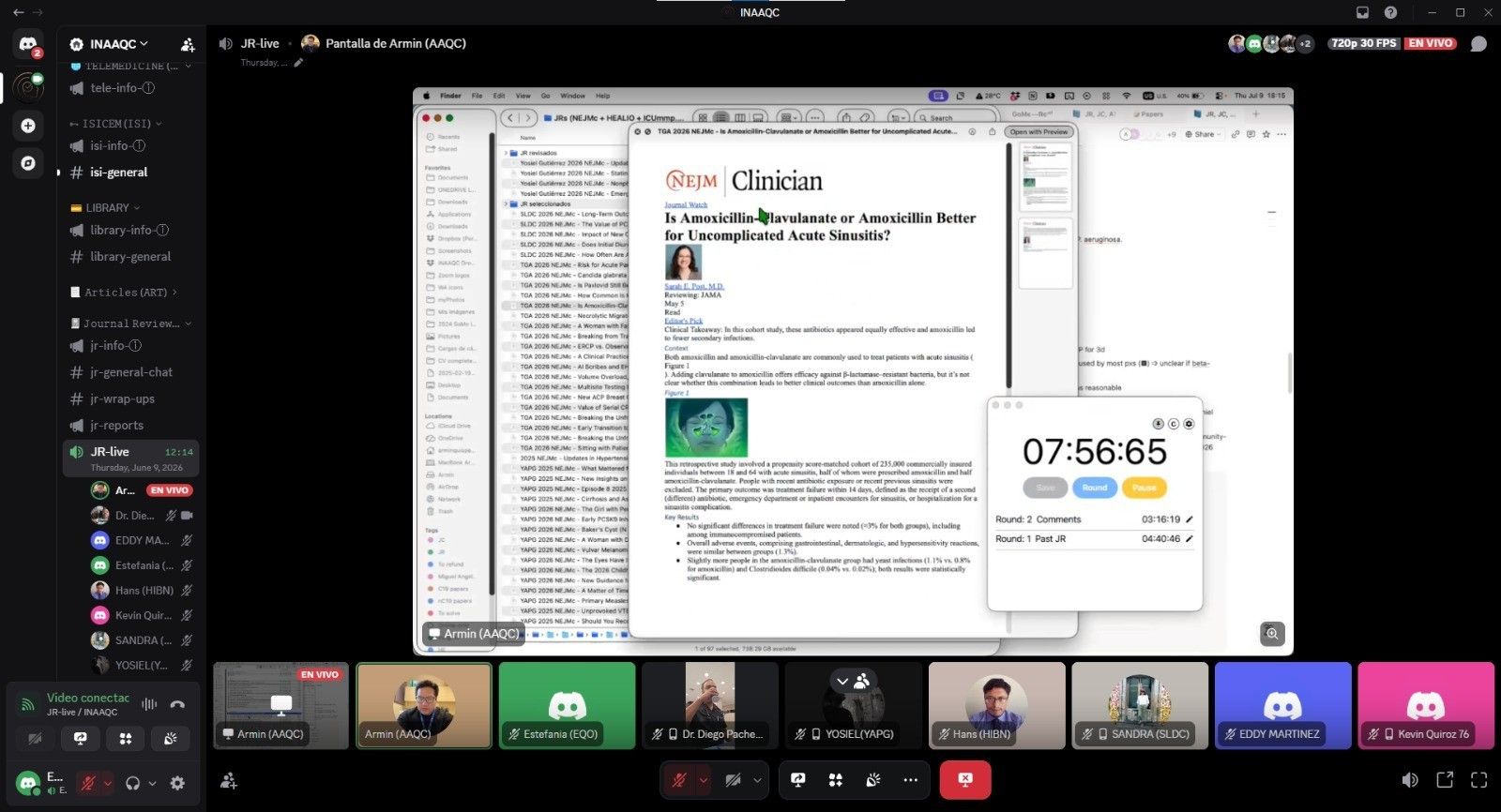
2026 HEALIO - New study could change practice for TTO sinusitis in adults (JAMA).pdf
Codified by 𝙄𝙉𝘼𝘼𝙌𝘾 ᴮᴼ (TGA)
Glossary: Æ = adverse events, DB = database, ESCMID = European Society of Clinical Microbiology and Infectious Diseases, ƒ-up = follow-up, GL = guidelines, IDSA = Infectious Diseases Society of America, outPxs = outpatients, R = resistance, secINF = secondary infections, TTO = treatment(s)
1. 𝙄𝙌𝘾 BS ➩ Y, J, C ➖ T ➕ N ➕ t ➖ P I C O:
2 𝙄𝙌𝘾 BS 🟰 2026, JAMA, USA ➖ obs_retro_real-world ➕ 230k (117,3k each cohort) ➕ Jan 2018 - Dec 2023 (5y) ➖ P I C O:
3. EVIDENCE:
a. GL IDSA 2012 prefer 🅸 over 🅲 ➩ as EMPIRIC TTO ▶︎ low-quality evidence
b. Clavulanate = beta-lactamase ⊖, added to amoxicillin to mitigate bacterial R.
c. Timothy Savage ➩ 4M → ATB prescriptions in USA each year
d. There NOT A CONSENSUS → 1st-line therapy
4. METHODS
- Acute sinusitis ⌄
- A complication (orbital cellulitis ⌄ osteomyelitis)
5. RESULTS.
a. Abstract presented in ESCMID.
b. <64yo
c. Oral agents:
i. 🅸 3,1%
ii. 🅲 3%
d. p🅾:
i. No DIFF in ATB Æ
ii. 🅸 40% more likely to experience ▶︎ sec_Yeast INF
iii. >2x as like to experience ▶︎ sec_Clostridoides difficile
f. New ATB dispensation (w_ ⌄ wo_outPx visit) ➩ 0.03%
g. Strengths → size ➕ scope
6. RATIONALE.
a. This new study casts DOUBT on the standard IDSA recommendation.
b. An attendee asked if an RCT was needed.
c. ❓ symptom-oriented outcomes
d. 🅸 NO advantage over 🅲 → regarding
EFFECTIVENESS
e. NO NOTABLE safety issues ↔ both options.
7. SOURCE: Savage TJ, Butler AM, Kronman MP, et al. Amoxicillin-Clavulanate vs Amoxicillin for Acute Sinusitis in Adults. JAMA. 2026;335(19):1694–1705. doi:10.1001/jama.2025.26902
Monday, July 6, 2026 at 18:35:02 in BE
EQO, LPM, OWGG, EMS, MLHG, BAR, HIBN, AAQC
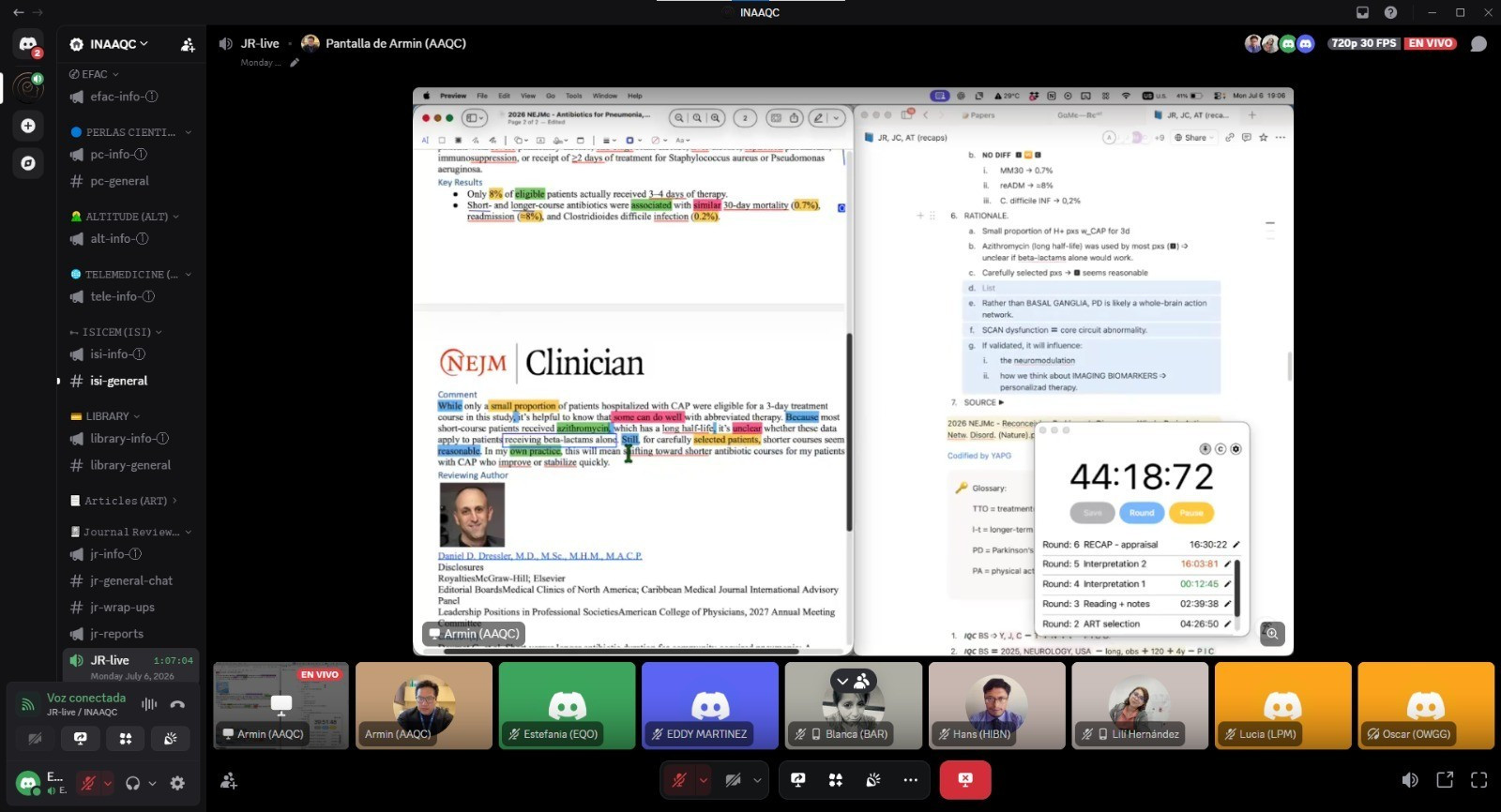
2026 NEJMc - Antibiotics for Pneumonia, Can Courses Get Even Shorter (Ann Intern Med).pdf
Codified by 𝙄𝙉𝘼𝘼𝙌𝘾 ᴮᴼ (TGA)
Glossary: ADM = admission, ATBs = antibiotics, INF = infection, lr = low-risk, tte = target trial emulation
tte = target trial emulation
1. 𝙄𝙌𝘾 𝙨𝙘𝙤𝙥𝙚 ▶︎ Y, J, C ➖ T ➕ N ➕ t ➖ P I C O:
2 2026, AIM, ❓ ➖ obs_tte ➕ 55k → 10% = 5620pxs ➕ ❓ ➖ P I C O:
🅿: nonsevere CAP
🅸: short-course (3-4d)
🅲: longer-course (≥5d)
🅾: OC = MM30 ➕ reADM ➕ C. difficile INF
3. EVIDENCE:
a. GL ★ at least 5d of ATBs
b. Newer guidance 🗣 shorter courses (3-4d) → nonsevere cases
4. METHODS.
Nonsevere case = clinical stability:
- vital signs
- mentation
5620 lr_pxs → tte comparing 🅸 🆚 🅲
EX (6)
- sev_🫁 DIS
- end-stage ♾️ stage
- ◸ DIS
- aspiration pneumonia
- immunosuppression
- ≥2d of TTO for S. aureus ⌄ P. aeruginosa.
5. RESULTS.
a. 8% elegible for 3-4d of TTO
b. 𝗡𝗢 𝗗𝗜𝗙𝗙 🅸 🆚 🅲
i. MM30 → 0.7%
ii. reADM → ≈8%
iii. C. difficile INF → 0,2%
6. RATIONALE.
a. Small proportion of H+ pxs w_CAP for 3d
b. Azithromycin (long half-life) was used by most pxs (🅸) ➩ unclear if beta-lactams alone would work.
c. Carefully selected pxs → 🅸 seems reasonable
d. ❝ In my own practice, this will mean shifting toward shorter antibiotic courses for my patients with CAP who improve or stabilize quickly. (Daniel Dressler)
7. SOURCE ▶︎ Doumat G, et al. Short versus longer antibiotic duration for community-acquired pneumonia: A multicenter target trial emulation. Ann Intern Med 2026 Apr 14; [e-pub]. DOI:10.7326/ANNALS-25-03538.
⏳ TIME MANAGEMENT
45:43:40
Round: 7 00:53:40 Comments
Round: 6 17:01:51 RECAP - appraisal
Round: 5 16:03:81 Interpretation 2
Round: 4 00:12:45 Interpretation 1
Round: 3 02:39:38 Reading + notes
Round: 2 04:26:50 ART selection
Round: 1 04:26:32 Past JR
2025 NEJMjw - Is FIT Testing an Alternative to Colonoscopy in pxs at hr_ f_ Colon CA (Clin Gastroenterol Hepatol).pdf
Codified by 𝙄𝙉𝘼𝘼𝙌𝘾 ᴮᴼ (RICH)
Glossary: COL = colonoscopy, CRC = colorectal cancer, FIT = fecal immunohistochemical testing, hr_ = high(er) risk, std = studies
1. 𝙄𝙌𝘾 BS ➩ Y, J, C ➖ T ➕ N ➕ t ➖ P I C O:
2 𝙄𝙌𝘾 BS 🟰 2025, CGH, EEUU ➖ sr ➕ 14 std ➕ ❓ ➖ P I C O:
3. EVIDENCE:
a. Pxs are reluctant to COL for CRC screening.
b. Type of risk:
i. average → FIT ✔︎
ii. high → FIT ❓
c. hr_CRC 🟰 history of polyps (personal) ➕ CRC (familiar)
4. RESULTS.
a. Variability in OC vas considerable, due to:
i. Heterogeneous designs
ii. DIFF DX thresholds → for ⊕ FIT
b. Sensitivity (hr_CRC) ➩ 25-100% (one-time FIT)
5. RATIONALE.
a. WE DO NOT HAVE ENOUGH evidence of FIT instead of COL. (hr_pxs)
b. Few studies ➩ beyond one-time testing.
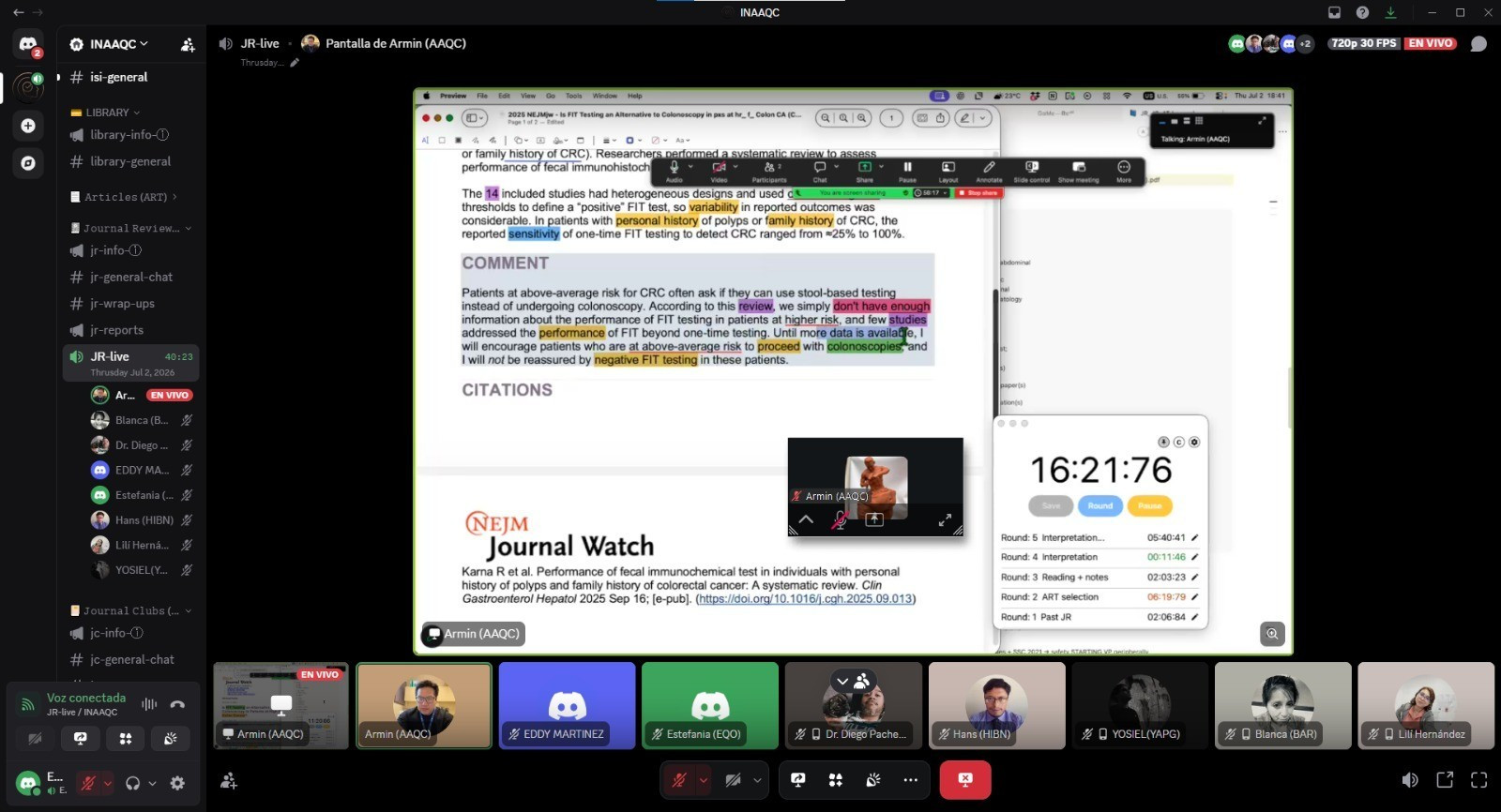
c. ❝I will not be reassured by negative FIT testing in these patients (Molly Brett)
6. SOURCE: Karna R et al. Performance of fecal immunochemical test in individuals with personal history of polyps and family history of colorectal cancer: A systematic review. Clin Gastroenterol Hepatol 2025 Sep 16; [e-pub]. (https://doi.org/10.1016/j.cgh.2025.09.013)
Thursday, July 2, 2026 at 18:20:30
EQO, EMS, YAPG, DEPZ, MLHG, BAR, HIBN, AAQC
⏳ TIME MANAGEMENT
37:50:14
Round: 8 00:02:09 Closure
Round: 7 03:54:41 Comments
Round: 6 15:51:45 RECAP
Round: 5 07:20:82 Interpretation...
Round: 4 00:11:46 Interpretation
Round: 3 02:03:23 Reading + notes
Round: 2 06:19:79 ART selection
Round: 1 02:06:84 Past JR
Thursday, July 16, 2026 at 18:30:26
EQO, OWGG, YAPG, EMS, LPM, KSQ, MLHG, AAQC
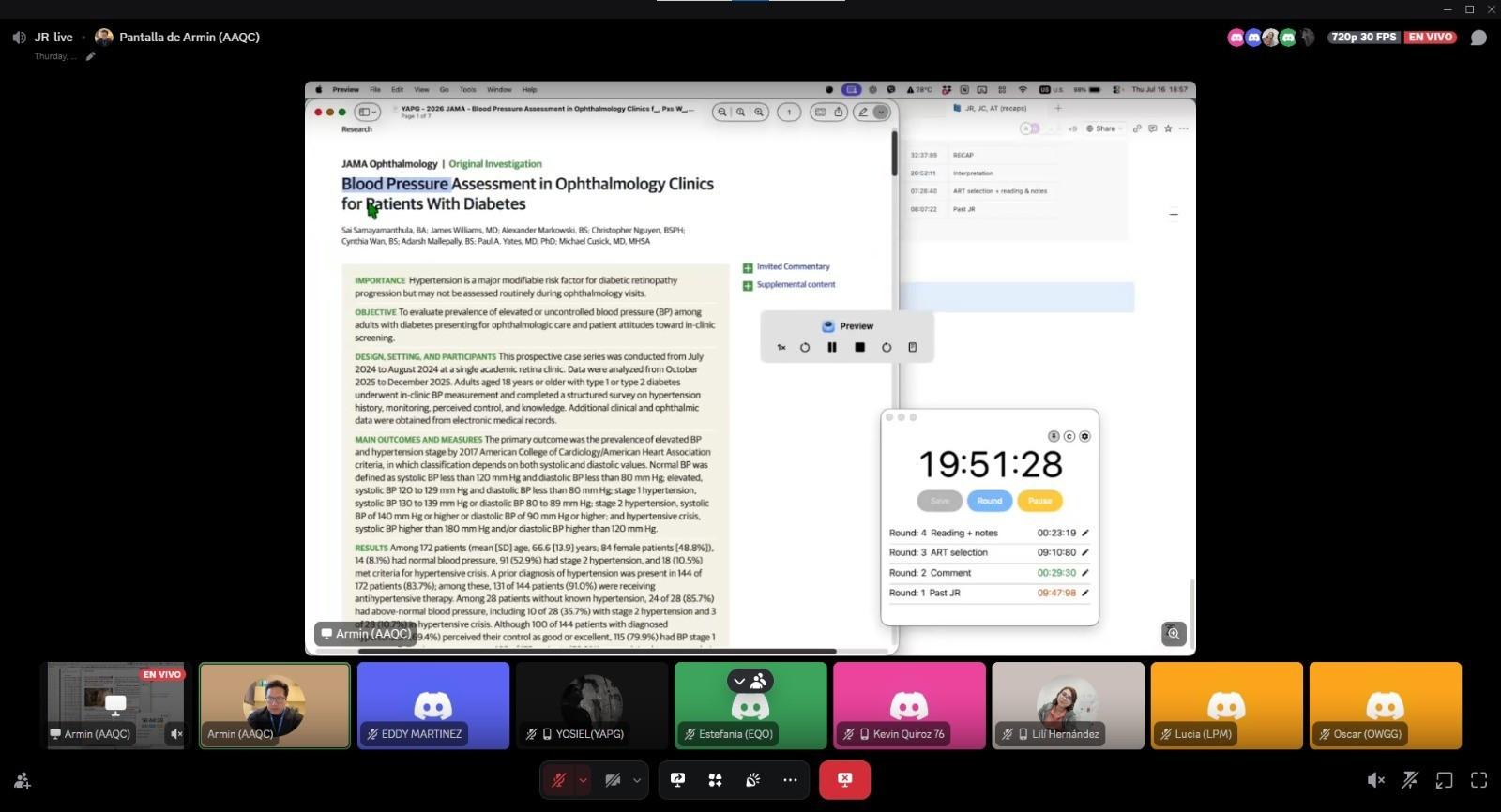
2026 JAMA - Blood Pressure Assessment in Ophthalmology Clinics f_Pxs w_Diabetes (Samayamanthula) [R].pdf
Codified by YAPG
Glossary: > = major, AMA/AHA = American College of Cardiology/American Heart Association, HTA = hypertension, hr_ = high(er) risk, PCC = primary care clinician, rf = risk factor, S1 = stage 1, S2 = stage 2
1. 𝙄𝙌𝘾 𝙨𝙘𝙤𝙥𝙚 ▶︎ Y, J, C ➖ T ➕ N ➕ t ➖ P I C O:
2. 2026, JAMA, USA 🇺🇸 ➖ pros_case series ➕ 172 ➕ Jul - Aug 2024 1m ➖ P I C O
🅿: adults w_diabetes presenting to a retina clinic
🅸: in-clinic BP measurements + survey + EMR data
🅲: NA
🅾: pOC = distribution of BP categories | sOC = prevalence of uncontrolled HTA ➕ concordance BP measures ↔ self-reported ➕ frequency of unDX & miscontrolled HTA ➕ awareness on eye impact ➕ perspective on in-office screening.
3. EVIDENCE:
a. HTA is >MODIFIABLE rf → for diabetic retinopathy
b. HTA may not be assessed d_ophtalmology visits
4. METHODS.
Analyzed Oct - Dec 2025
Survey:
- HTA history
- monitoring
- perceived control
- knowledge
DEF (AMA/AHA 2017)
- Normal BP → SBP<120 ➕ DBP <80
- Elevated → SBP 120-129 ➕ DBP <80
- S1 HTA → SBP 130-139 ⌄ DBP 80-89
- S2 HTA → SBP ≥140 ⌄ DBP ≥90
- Crisis → SBP>180 ± DBP >120
5. RESULTS.
a. 66yo
b. ♀ 49%
c. Normal → 8%
d. S2 → 53%
e. Crisis → 10%
f. Prior DX → 84%
i. w_TTO = 91%
g. wo_known HTA → Above-normal BP = 86%
i. S2 & S3 → 35%
ii. crisis → 11%
h. Although 69% w_HTA perceived GOOD ⌄ excellent CONTROL:
i. S1 ⌄ > = 80%
i. Following measurements
i. advised to contact their PCC = 60%
ii. expedited ƒ-up = 12%
6. RATIONALE.
a. Highly prevalent HTA→ UNCONTROLLED ⌄ PREV unrecognized
b. Screening is FEASIBLE in ophtalmology clinics
c. ACTIONABLE CVr may be identified
7. SOURCE ▶︎ Samayamanthula S, Williams J, Markowski A, et al. Blood Pressure Assessment in Ophthalmology Clinics for Patients With Diabetes. JAMA Ophthalmol. Published online June 25, 2026. doi:10.1001/jamaophthalmol.2026.2245
⏳ TIME MANAGEMENT
01:31:19
Round: 8 00:01:24 Closure
Round: 7 12:19:13 Comments
Round: 6 33:05:45 RECAP
Round: 5 21:34:79 Interpretation
Round: 4 04:50:81 Reading + notes
Round: 3 09:10:80 ART selection
Round: 2 00:29:30 Comment
Round: 1 09:47:98 Past JR
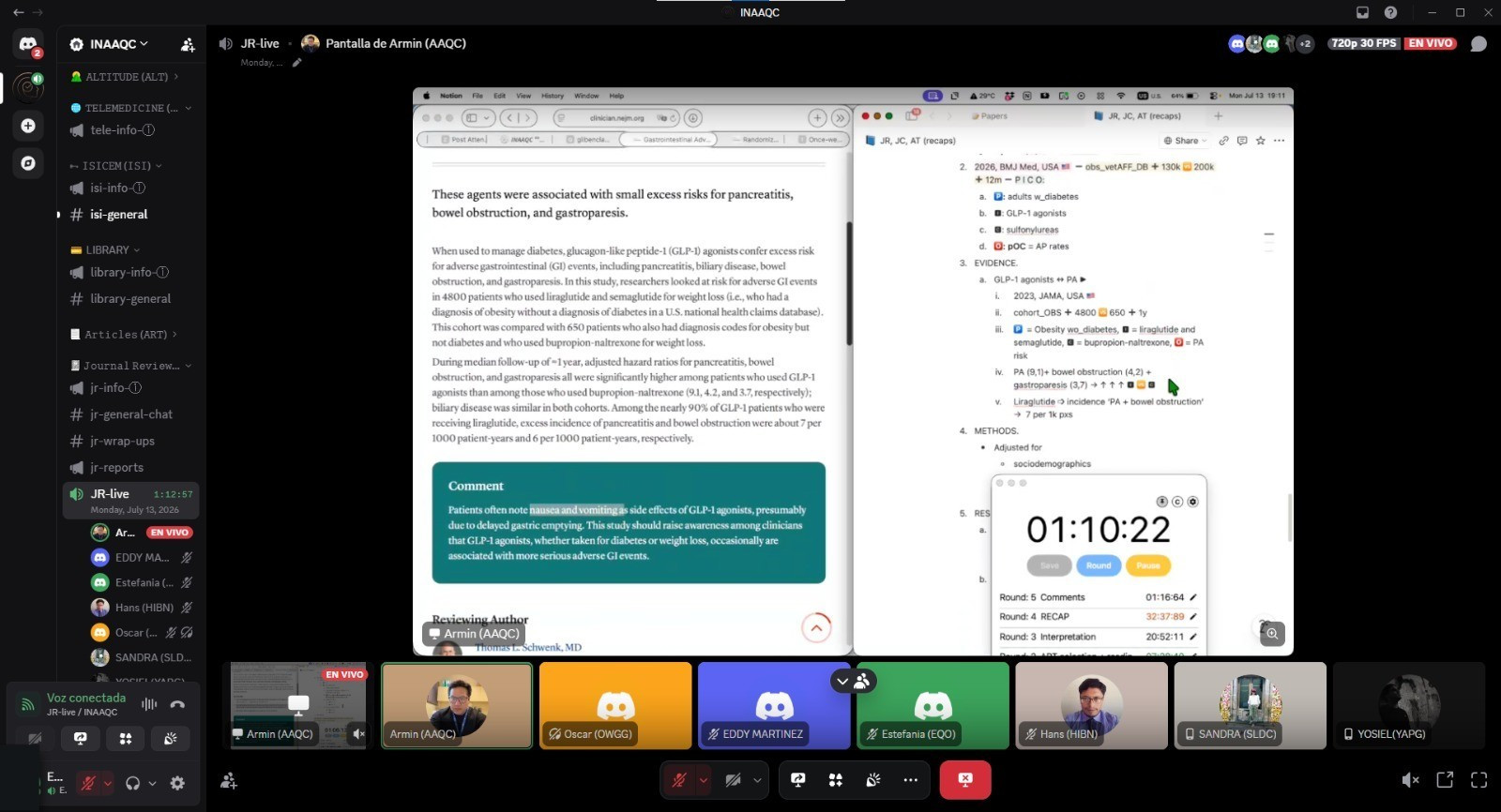
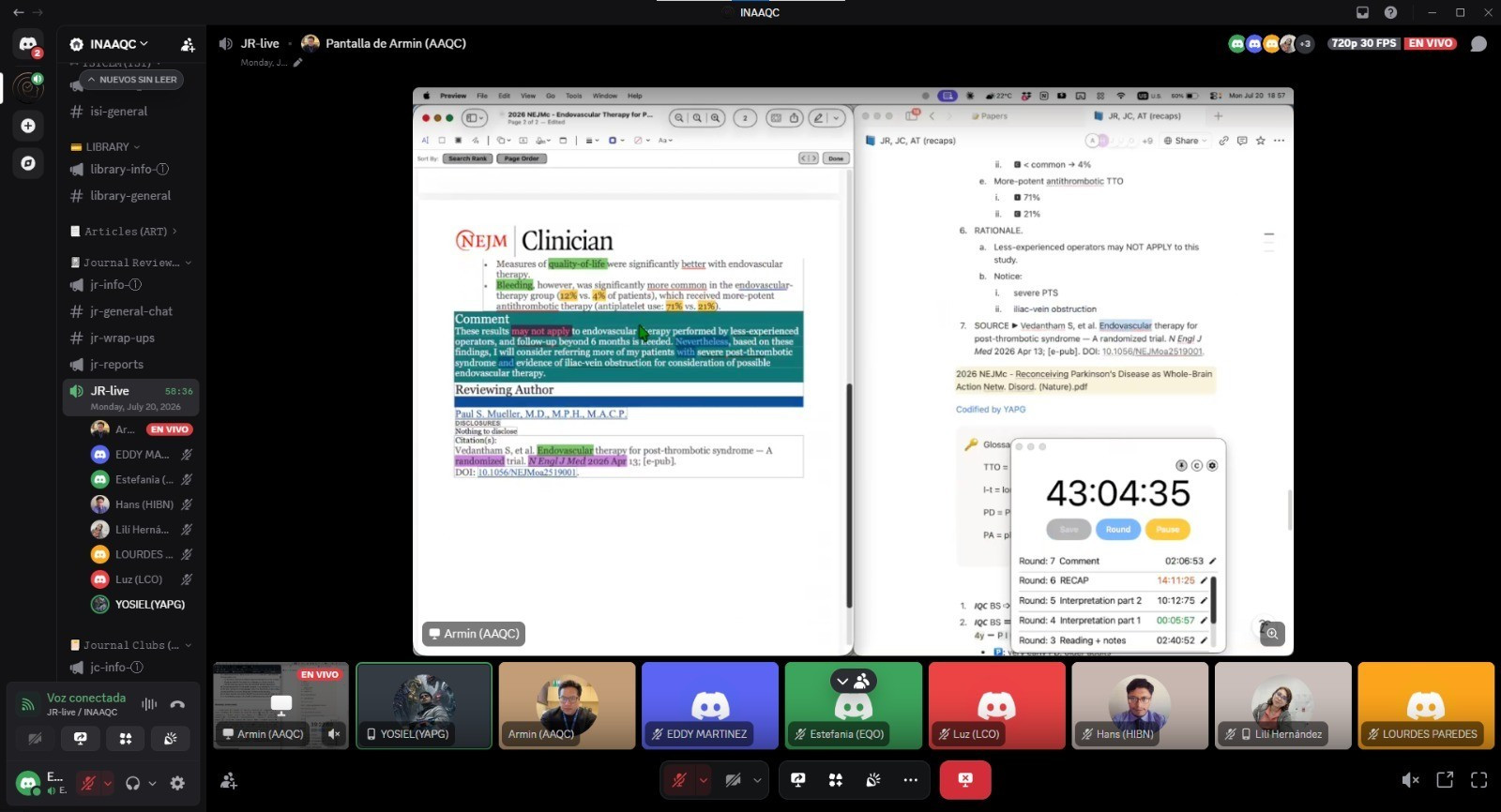
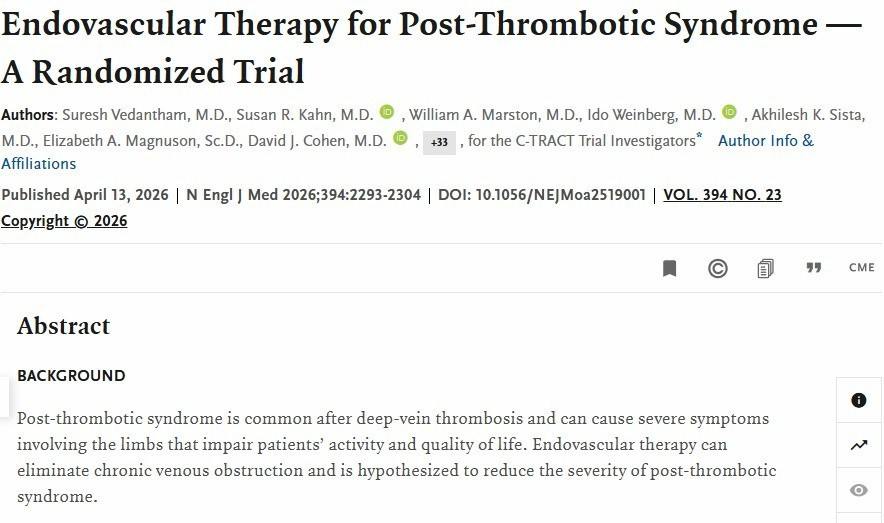
2026 NEJMc - Endovascular Therapy for Patients w_Post-Thrombotic Syndrome (NEJM).pdf
Codified by YAPG
Glossary: DVT = deep venous thrombosis, PTS = post-thrombotic syndrome, SOC = standard of care, VCSS = Venous Clinical Severity Score
1. 𝙄𝙌𝘾 𝙨𝙘𝙤𝙥𝙚 ▶︎ Y, J, C ➖ T ➕ N ➕ t ➖ P I C O:
2. 2026, NEJM, ❓ ➖ RCT ➕ 225 pxs ➕ ❓(ƒ-up 6m) ➖ P I C O:
3. EVIDENCE:
a. PTS af_acute lower-extremity DVT:
i. pain
ii. pruritus
iii. edema
iv. ulceration
b. Common in PROXIMAL DVT → iliac-vein obstruction
4. METHODS.
- iliac-vein stent
- antiCOA ≥6m
- aspirin
- knowledge
5. RESULTS.
a. Baseline → 🅾 12 pts
b. 6m → 🅾 (p<0.05)
i. 🅸 -4
ii. 🅲 -2
c. QOL ↗️
i. 🅸 ✔︎
ii. 🅲 ✖︎
d. Bleeding
i. 🅸 > common → 12%
ii. 🅲 < common → 4%
e. More-potent antithrombotic TTO
i. 🅸 71%
ii. 🅲 21%
6. RATIONALE
a. Less-experienced operators may NOT APPLY to this study.
b. Notice:
7. SOURCE ▶︎ Vedantham S, et al. Endovascular therapy for post-thrombotic syndrome — A randomized trial. N Engl J Med 2026 Apr 13; [e-pub]. DOI: 10.1056/NEJMoa2519001.
Monday, July 20, 2026 at 18:10:22
EQO, LCO, EMS, LP, MLHG, YAPG, HIBN, AAQC
2025 NEJMc - Cefixime, Might It Be an Option f_ Treating Early Syphilis (JAC).pdf
Codified by YAPG
Glossary: BPG = benzathine penicillin G, RPR = rapid plasma reagin, VDRL = Venereal Disease Research Laboratory test
1. 𝙄𝙌𝘾 𝙨𝙘𝙤𝙥𝙚 ▶︎ Y, J, C ➖ T ➕ N ➕ t ➖ P I C O:
2. 2026, NEJM, ❓ ➖ RCT ➕ 225 pxs ➕ ❓VDRL (ƒ-up 6m) ➖ P I C O:
- pOC = ↓≥4-fold VDRL at 3m
- sOC = ↓≥4-fold VDRL at 12m
3. EVIDENCE:
a. ↑ prevalence syphilis
b. shortage of BPG
c. Abstract cited
i. mc_RCT
ii. 134 pxs (67% w_HIV)
iii. 🅸 400mg BID f_10d 🟰 88%
iv. 🅲 same as current 🟰 89%
v. pOC = ↓≥4-fold RPR at 3m ⌄ 6m
4. RESULTS.
a. pOC (3m)
i. 🅸 73%
ii. 🅲 87%
b. sOC (12m)
i. 🅸 93%
ii. 🅲 97%
c. Tolerance
i. 🅸 ✔︎
ii. 🅲 ✔︎
5. SOURCE ▶︎ Klementová T et al. Cefixime versus benzathine penicillin G for the treatment of early syphilis — A randomized, controlled open label trial. J Antimicrob Chemother 2025 Aug 7; [e-pub]. (https://doi.org/10.1093/jac/dkaf268)
⏳ TIME MANAGEMENT
01:31:19
Round: 8 00:01:24 Closure
Round: 7 12:19:13 Comments
Round: 6 33:05:45 RECAP
Round: 5 21:34:79 Interpretation
Round: 4 04:50:81 Reading + notes
Round: 3 09:10:80 ART selection
Round: 2 00:29:30 Comment
Round: 1 09:47:98 Past JR
Monday, August 10, 2026 at 18:02:20 CEST
EQO, LCO, EMS, SLDC, HIBN, AAQC
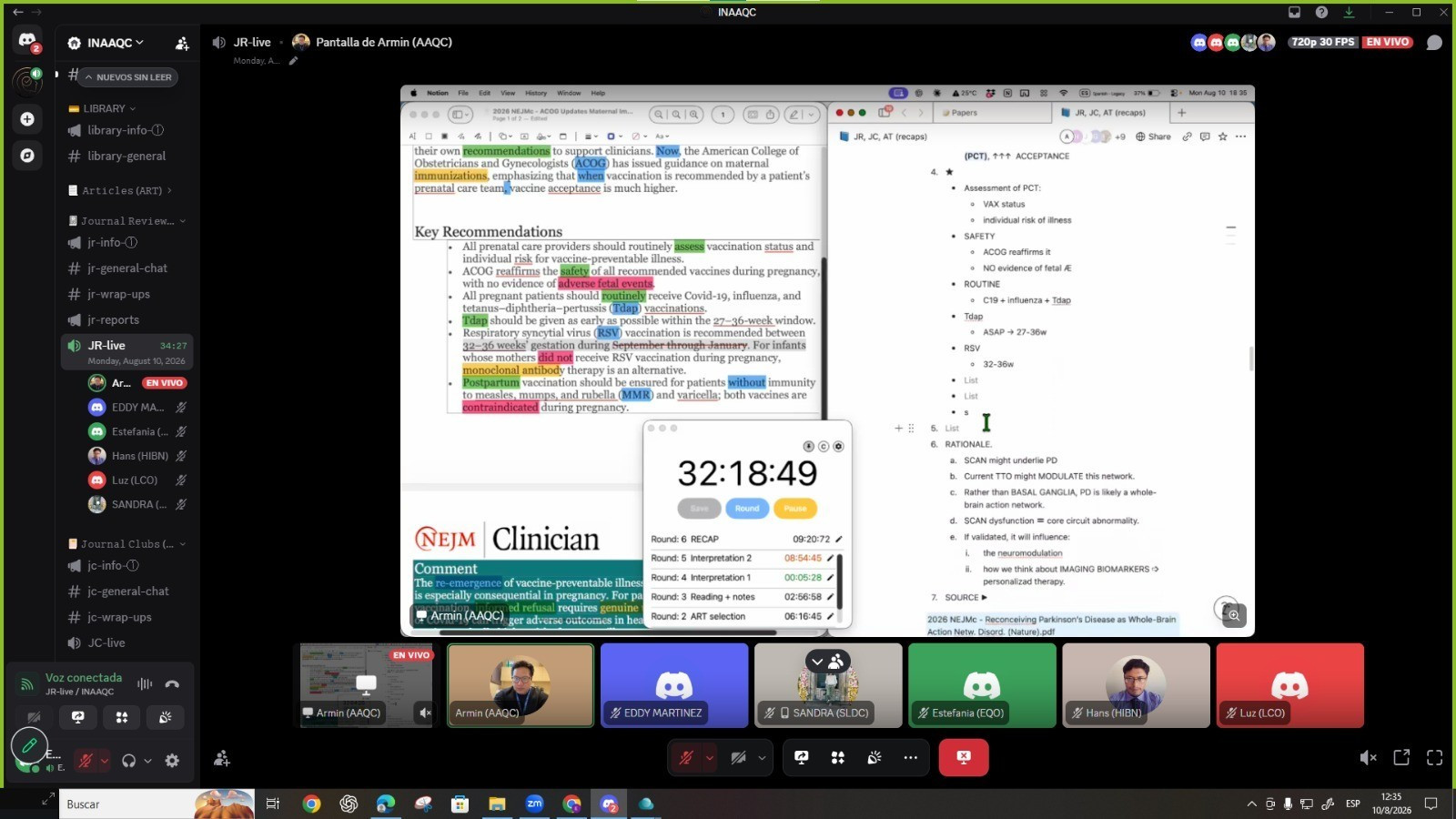
2026 NEJMc - ACOG Updates Maternal Immunization Guidance (Obstet Gynecol).pdf
Codified by YAPG
Glossary: mAb = monoclonal antibody, MMR = measles, mumps, and rubella, PCT = prenatal care team, PH = public health, Tdap = tetanus–diphtheria–pertussis, VAX = vaccination, vaccine
1. 𝙄𝙌𝘾 𝙨𝙘𝙤𝙥𝙚 ▶︎ Y, J, C ➖ T ➕ N ➕ t ➖ P I C O:
2. 2026, OG, 🇺🇸 ➖ GL ➕ NA ➕ NA ➖ P I C O: NA
3. EVIDENCE:
a. Prenatal VAX rates ↓ in recent years:
i. mistrust
ii. shift of PH guidance
b. Many organizations have ★
c. ACOG ▶︎ when VAX is ★ by pxs’ prenatal care team (PCT), ↑↑↑ ACCEPTANCE
4. ★.
- VAX status
- individual risk of illness
- ACOG reaffirms it
- NO evidence of fetal Æ
- C19 + influenza + Tdap
- ASAP → 27-36w
- 32-36w
- Sep-Jan
- IF mother DID NOT receive → mAb is an option
- MMR
- VARICELLA
- Both are CONTRAINDICATED d_preg
5. RATIONALE.
a. Re-emergence of this illnesses is a REALITY (USA)
b. Genuine understanding of consequences:
i. mild cases of C19 → adverse OC
ii. Influenza → severe illness + H+
c. USA has the highest MM rate in the world (despite low risk)
d. Make sure pxs understand CONTEXT
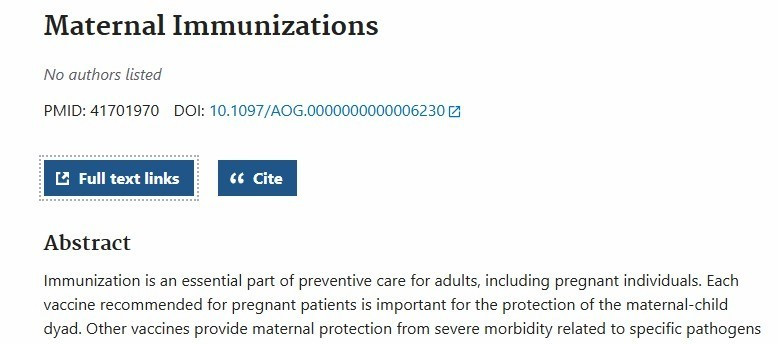
6. SOURCE ▶︎ Maternal Immunizations. Obstet Gynecol 2026 May 1; 147:e123. DOI: 10.1097/AOG.0000000000006230. PubMed
⏳ TIME MANAGEMENT
55:16:16
Round: 7 02:18:05 Comments
Round: 6 21:36:73 RECAP
Round: 5 08:41:61 Interpretation
Round: 4 02:59:85 Reading + notes
Round: 3 06:25:24 ART selection
Round: 2 00:51:92 Comments
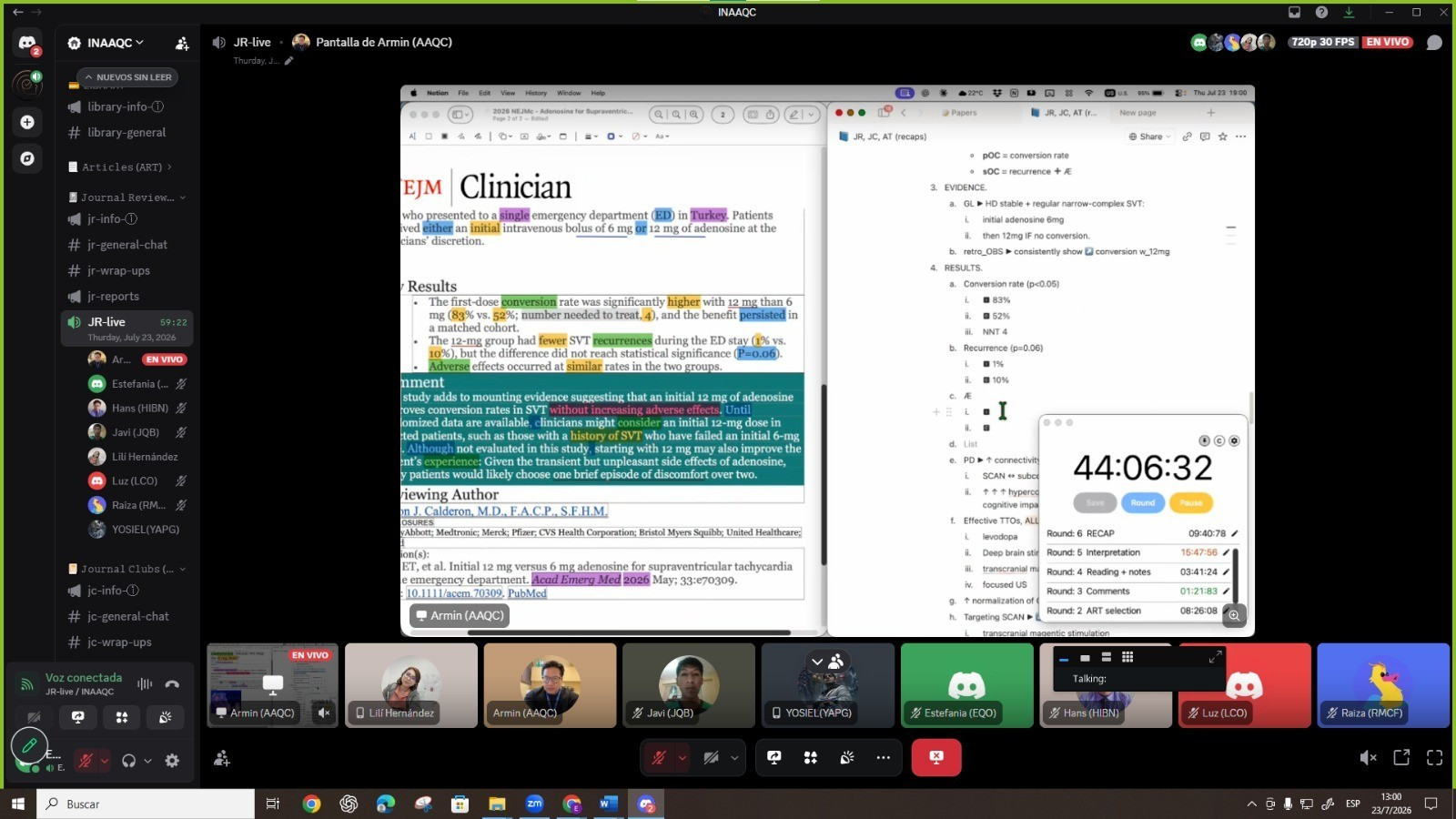
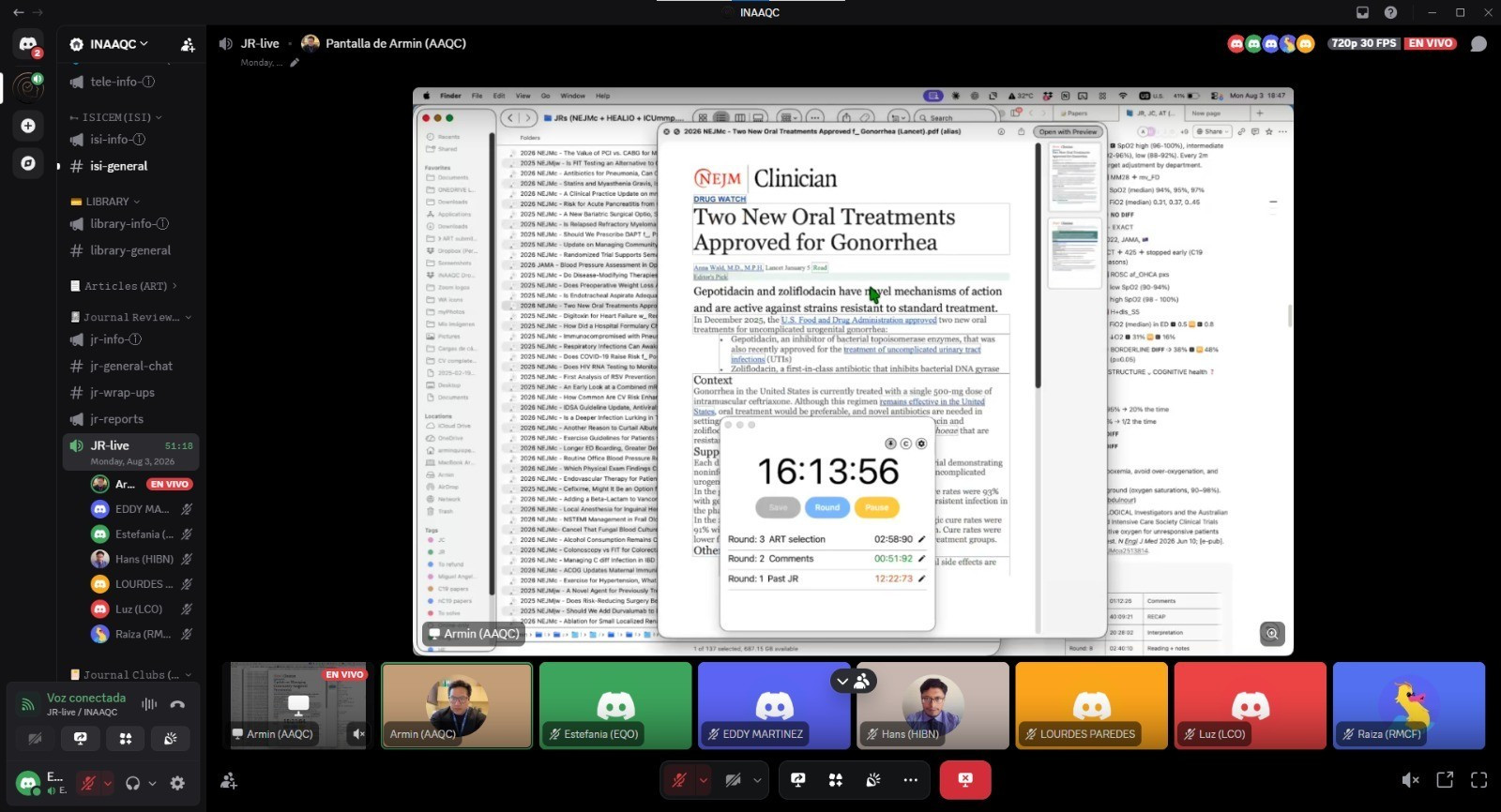
Round: 1 12:22:73 Past JR
2026 NEJMc - Local Anesthesia for Inguinal Hernia Repair (Surgery).pdf
Codified by YAPG
Glossary: COM30 = complications at 30days, INB = ilioinguinal nerve block, intra_OP = intraoperative, post_OP = postoperative
1. 𝙄𝙌𝘾 𝙨𝙘𝙤𝙥𝙚 ▶︎ Y, J, C ➖ T ➕ N ➕ t ➖ P I C O:
2. 2026, SURGERY, ❓ ➖ mc_OBS ➕ 164 ➕ ❓(ƒ-up 1,5y) ➖ P I C O:
3. EVIDENCE:
a. Symptomatic inguinal hernias = surgical repair
b. General anesthesia risks → new option is INB
c. Limited data
i. 2023, JAMA Surg, 🇺🇸 (U.S. Veterans Affairs)
ii. retro_OBS ➕ 107k ➕ ❓
iii. 🅿 inguinal hernia
iv. 🅸
- open repair under general anesthesia
- open repair under local anesthesia
- laparoscopic repair
v. 🅲 NA
vi. 🅾 complications
vii. ® COM30
- general 🆚 laparos “1% ↓“
- local 🆚 laparos → 𝗡𝗢 𝗗𝗜𝗙𝗙
viii. ® TIME
4. RESULTS.
a. 71yo → DM 15% ➕ ‘⤹🫀DIS’ 45%
b. intra_OP COM → NONE
c. post_OP COM:
i. seroma → 9%
ii. temporary drain → 1px
iii. observation → the rest
d. Urinary retention → 4%
e. Cellulitis → 3pxs (2%)
f. Recurrences ➕ mesh INF → NONE
g. Bill → 6000 USD
6. RATIONALE.
a. Minimal symptoms + comorbilities → might make us doubt on GENERAL ANESTHESIA
b. Price is ↓
i. robotic
ii. laparoscopic
c. Check availability w_trusted surgical team
6. SOURCE ▶︎
▶︎ Wiley AJ, et al. Utilizing local anesthesia and monitored anesthesia care sedation in open inguinal hernia repair in complex, comorbid patients. Surgery 2026 Mar; 191:109910. DOI: 10.1016/j.surg.2025.109910.
Monday, August 17, 2026 at 18:20:32 CEST
EQO, LP, YZE, EMS, HIBN, AAQC
2026 NEJMc - 2026 Guidelines on Managing Pediatric Constipation (J Pediatr Gastroenterol Nutr).pdf
Codified by LCO
Glossary: ★ = recommendation(s), GPS = good practice statements, PEG = polyethylene glycol, PG = pediatric gastroenterologist, QOL = quality of life, Sx = surgery, TTO = treatment(s)
𝙄𝙌𝘾 𝙨𝙘𝙤𝙥𝙚 ▶︎ Y, J, C ➖ T ➕ N ➕ t ➖ P I C O:
2026, JPGN, 🇪🇺 🇺🇸 ➖ GL ➕ 102 RCT ➕ ❓ ➖ P I C O:
3. EVIDENCE.
a. Children functional constipation impairs QOL
b. Update ▶︎ 2014 GL
4. METHODS.
5. RESULTS.
a. Issued:
i. 11 evidence-based ★
ii. 19 GPS
iii. Stepwise TTO algorithm
b. PHARMACOLOGIC
i. PEG (w_ ⌄ wo_ electrolytes) → maintenance
ii. Milk of magnesia
1. less success than PEG
2. ↑ withdrawals → ↑ Æ
iii. Linaclotide
1. 6 - 17yo
2. Only when TTO failure
3. Prescribed by PG
iv. Enemas + rectal suppositories
1. NOT SUGGESTED as maintenance
2. due to psychosocial impact
v. Enemas ⌄ high-dose oral PEG (1-1.5 g/Kg/d)
1. fecal impaction
c. NONPHARMACOLOGIC
i. Balanced diet
1. water
2. fiber
3. toilet-training program
ii. Adjunt options
1. probiotic
2. synbiotic
3. physiotherapy (pelvic floor)
4. neurostimulation w_pelvic floor exercises
iii. Cow’s milk-free diet
1. can be trialed
2. when cow’s milk allergy is suspected
3. when not responded to conventional TTO
d. ADDITIONAL
i. Lactulose + laxatives (bisacodyl, senna, or sodium picosulfate)
1. limited evidence
ii. Mineral oil → NOT ★ (Æ)
iii. Sx → refractory constipation (medical TTO)
6. RATIONALE.
a. PEG = Miralax → 1st line
b. Understand the parents (immediate relief)
c. See table 10 for doses.
d. ❝ Although high-dose PEG can require a challenging volume, I’ve had success administering it through a nasogastric tube. (Clement Lee)
7. SOURCE ▶︎ Gordon M, et al. European Society for Paediatric Gastroenterology, Hepatology and Nutrition/North American Society for Pediatric Gastroenterology, Hepatology and Nutrition guidelines for treatment of functional constipation in children aged 0–18years. J Pediatr Gastroenterol Nutr 2026 May 20; [e-pub]. DOI: 10.1002/jpn3.70447. PubMed
⏳ TIME MANAGEMENT
01:05:45
Round: 6 09:07:23 Comments
Round: 5 30:51:81 RECAP
Round: 4 10:07:85 Interpretation
Round: 3 03:53:82 Reading + notes
Round: 2 06:43:54 ART selection
Round: 1 05:01:54 Past JR
Thursday, August 13, 2026 at 18:05:31 CEST
EQO, RCH, LP, YZE, EMS, HIBN, AAQC
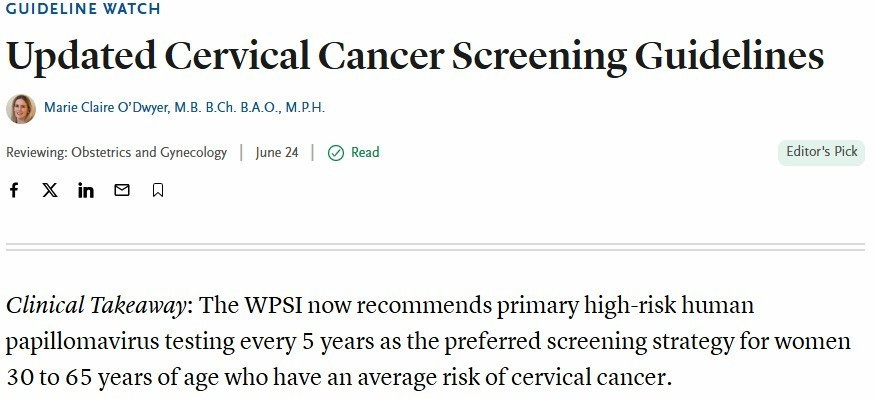
2026 NEJMc - Updated Cervical Cancer Screening Guidelines (Obstet Gynecol).pdf
Codified by YAPG
Glossary: ★ = recommendation(s), COTESTING = cytology + hrHPV, hrHPV = high-risk human papillomavirus, mm = management, WPSI = Women’s Preventive Services Initiative
𝙄𝙌𝘾 𝙨𝙘𝙤𝙥𝙚 ▶︎ Y, J, C ➖ T ➕ N ➕ t ➖ P I C O:
2026, OG, 🇺🇸 ➖ GL ➕ NA ➕ NA ➖ P I C O:
3. EVIDENCE:
a. January 2026 ▶︎ WPSI presented the CA screening GL
4. METHODS.
- HIV INF
- immunosuppression
- in utero diethylstilbestrol exposure
- History of grade ≥2 cervical dysplasia
5. RESULTS.
a. Cervical CA screening → 21-65yo
b. 21-29yo RED + 30-65 GREEN
c. Cytology:
i. 21-29yo ▶︎ should NOT receive COTESTING
ii. every 3y (maintains)
d. Primary hrHPV testing:
i. 30-65yo
ii. every 5y (🆕)
iii. COTESTING every 5y (maintains)
iv. Cytology alone (when hrHPV unavailable) every 3y (maintains)
e. px-collected hrHPV:
i. 30-65yo
ii. ACCURACY → pxs 🆚 clinicians → 𝗡𝗢 𝗗𝗜𝗙𝗙
6. RATIONALE.
a. ACOG:
i. endorsed these ★
ii. px-collected hrHPV testing → every 3y (instead of 5y) only when these systems are in place:
- notificaión
- ƒ-up
b. More common currently (px-collected one)
c. To evaluate:
i. ↓ cervical CA incidence
ii. MM
SOURCE ▶︎ Vosooney A, et al. Screening for Cervical Cancer: A Recommendation From the Women’s Preventive Services Initiative. Obstet Gynecol 2026 Jul; 148:e3. DOI: 10.1097/AOG.0000000000006315.
⏳ TIME MANAGEMENT
57:29:78
Round: 6 06:57:56 Comments
Round: 5 17:18:87 RECAP
Round: 4 11:19:94 Interpretation'
Round: 3 03:18:41 Reading + notes
Round: 2 07:19:66 ART selection
Round: 1 11:15:32 Past JR
Thursday, August 20, 2026 at 18:05:38 CEST
EQO, YZE, EMS, HIBN, AAQC
2026 USweb - Dietary guidelines for Americans (FedGov) [GL].pdf
Codified by 𝙄𝙉𝘼𝘼𝙌𝘾 ᴮᴼ (AAQC)
Glossary: cDIS = chronic disease, FFQ = food frequency questionnaire, HC = healthcare, moo = microorganisms, semiQ = semiquantitative
1. 𝙄𝙌𝘾 𝙨𝙘𝙤𝙥𝙚 ▶︎ Y, J, C ➖ T ➕ N ➕ t ➖ P I C O:
2. 2026, USweb, 🇺🇸 ➖ GL ➕ NA ➕ NA ➖ P I C O: 🅿: Adults
3. EVIDENCE.
a. 90% of HC spending → TTO
b. cDIS:
i. genetic destiny ✖︎
ii. predictable result ✔︎ ➩ highly processed foods + sedentarism
c. >70% are overweight ⌄ obese
d. 1 in 3 → prediabetes (12-17yo)
4. METHODS.
5. RESULTS.
a. AMOUNT:
i. Calories → depends on age, sex, height, weight, and level of
physical activity.
ii. Portion → pay attention
iii. Hydration → KEY FACTOR (water + unsweetened beverages)
b. PROTEIN
i. High-quality → nutrient-dense
ii. Variety →
1. animal: eggs, poultry, seafood, and red meat,
2. plant-sourced: beans, peas, lentils, legumes, nuts, seeds,
and soy.
iii. Method →
1. ✖︎ deep-fried cooking n
2. ✔︎ baked, broiled, roasted, stir-fried, or grilled cooking
iv. Meat → no sugar + carbohydrates ⌄ starches ⌄ CHEMICAL ADDITIVES
v. Serving goals → 1,2-1,6 g/Kg/d (adjusted to Cal requirements)
c. DAIRY
i. Full-fat dairy w_NO added sugar
ii. protein, healthy fats, vitamins, and minerals.
iii. Serving goals → 3 servings (2000 Cal, adjusted)
d. GUT HEALTH = Microbiome = trillons of bacteria + other moo
i. Support
1. healthy diet
2. Vegetables
3. Fruits
4. Fermented foods → sauerkraut, kimchi, kefir, miso
5. High-fiber foods
ii. Disrupt
1. highly processed foods
e. VEGGIES + FRUITS
i. Colorful
ii. Original form → WASH THOROUGHLY
iii. Frozen, dried, or canned (NO or ↓ added sugars)
iv. OK to use salt + spices + herbs
v. 100% juice → in LIMITED PORTIONS or DILUTED w_water
vi. 2021 CRICULATION 🇺🇸 ➖ MA + OBS ➕ >65k ♀ >40k ♂︎ ➕ NA ➖
1. 🅿 adults wo_cDIS at baseline
2. 🅸 validated semiQ FFQ
3. 🅲 NA
4. 🅾 acMM + espMM (CA + 🫁 + 🫀 )
5. ®
a. 100-87 = 13% total MM
b. 100-88 = 12% 🫀 MM
c. 100-90 = 10% CA MM
d. 100-65 = 35% 🫁 MM
vii. VEGGIES: 3 serving/day ➕ FRUITS: 2 serving/day
f. HEALTHY FATS
i. Plentiful in WHOLE FOODS → meats, poultry, eggs,
ii. Olive oil
iii. Butter ⌄ BEEF TALLOW
iv. Saturated fat → <10% of Cal
v. Type of fats BEST for l-t health ➩ ↑ high-quality research is needed
g. ...
6. SOURCE ▶︎ https://www.dietaryguidelines.gov/?utm_source=chatgpt.com
⏳ TIME MANAGEMENT
01:35:38
Round: 6 00:56:85 Comments
Round: 5 32:56:40 RECAP
Round: 4 45:19:41 Interpretation
Round: 3 04:25:83 Reading + notes
Round: 2 06:41:59 ART selection
Round: 1 05:18:59 Past JR
Monday, August 24, 2026 at 18:00:24 CEST
EQO, LCO, BAR, RCH, HIBN, AAQC
2026 NEJMc - Sitting with Patients at the Bedside (J Hosp Med).pdf
Codified by 𝙄𝙉𝘼𝘼𝙌𝘾 ᴮᴼ (TGA)
Glossary: d_ = during, INF = infection, JHM = Journal of Hospital Medicine
1. 𝙄𝙌𝘾 𝙨𝙘𝙤𝙥𝙚 ▶︎ Y, J, C ➖ T ➕ N ➕ t ➖ P I C O:
2. 2026, JHM, ❓ ➖ r ➕ NA ➕ ❓ ➖ P I C O:
3. EVIDENCE.
a. Standing at the beside d_encounters → makes us believe it:
i. saves time
ii. improve clinical efficiency
4. METHODS.
5. RESULTS.
a. Pxs’ preference
i. Studies ▶︎ they prefer clinicians to sit
b. Communication
i. RCT (small) ▶︎ ↗️ significantly w_🅸
c. Visit duration
i. Multiple studies ▶︎ 🅸 DOES NOT ↑
d. Pxs’ perception
i. AS LONGER when physicians are seated
⏳ TIME MANAGEMENT
01:00:16
Round: 7 1:32:76 Closure
Round: 6 10:17:72 Comments
Round: 5 20:02:89 Wrap-up
Round: 4 15:09:52 Interpretation
Round: 3 02:49:09 Reading + notes
Round: 2 03:07:86 ART selection
Round: 1 07:57:68 Past JR
6. RATIONALE.
a. Time to abandon STANDING at the bedside.
b. ❝ sometimes kneel… avoid sitting on the edge… for purposes of INF + PRIVACY (Daniel Dressler)
c. Same time ➩ pxs feel more HEARD ➕ acknowledged.
d. Unpublished data ▶︎ satifaction scores ↗️ when sitting
e. 🅸 → inconvenient BUT worth it
7. SOURCE ▶︎ Gray A, et al. Things We Do for No Reason™: Standing at the bedside. J Hosp Med 2026 Feb 22; [e-pub]. DOI: 10.1002/jhm.70293.
Monday, August 31, 2026 at 19:07:23 CEST
EQO, KEC, YZE, EMS, AAQC
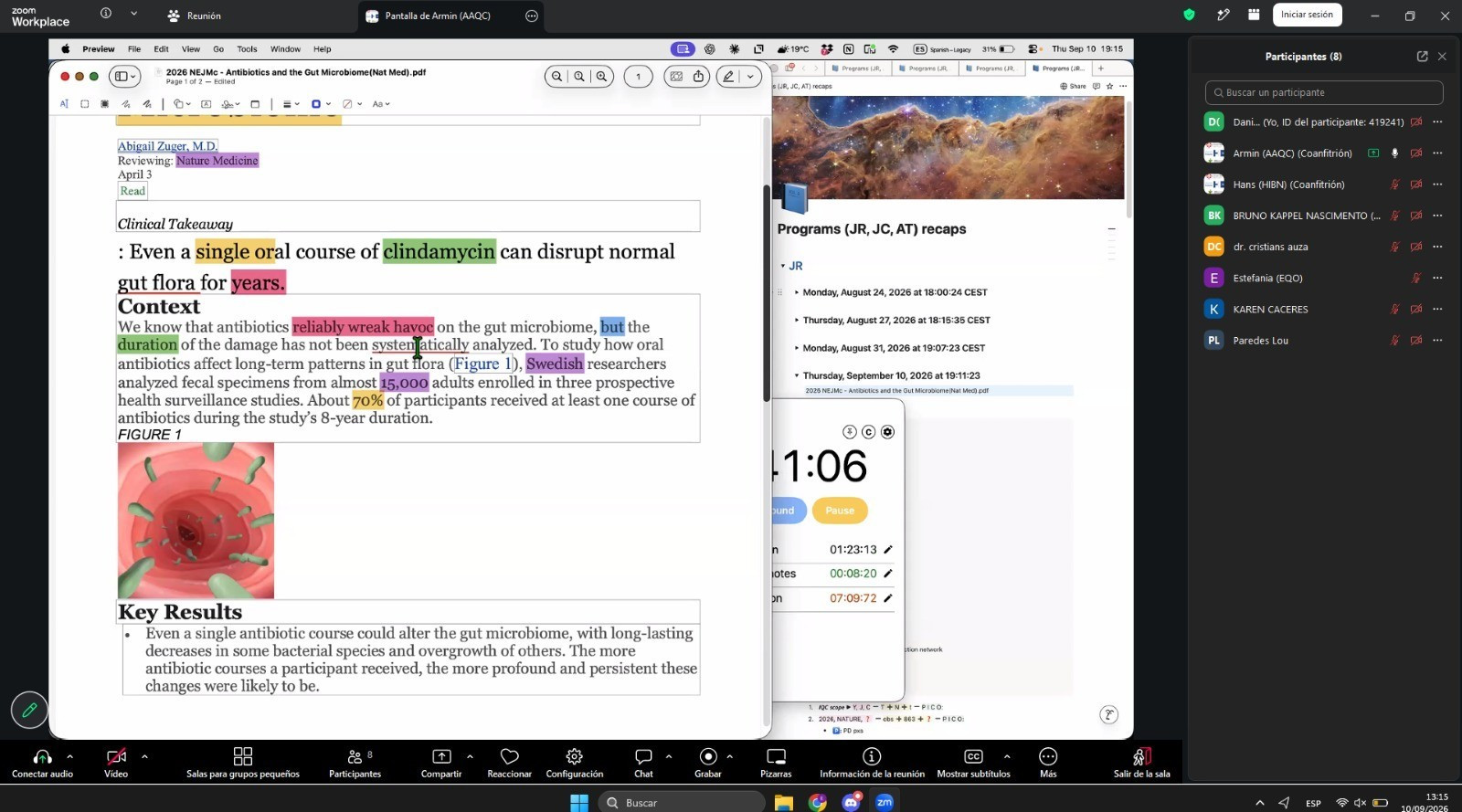
2026 NEJMc - Antibiotics and the Gut Microbiome(Nat Med).pdf
Codified by YAPG
Glossary: CVD = cardiovascular DIS, DIS = diseases, DM = diabetes, l-t = long-term.
1. 𝙄𝙌𝘾 𝙨𝙘𝙤𝙥𝙚 ▶︎ Y, J, C ➖ T ➕ N ➕ t ➖ P I C O:
2.2026, Nat Med, SW ➖ 🤓 pros_SURVEILL studies ➕ 15k ➕ 8y ➖ P I C O:
3. EVIDENCE.
a. ATBs → reliably wreak havoc ➩ gut microbiome
b. Duration is unknown (systematically)
4. RESULTS.
a. 70% = ONE COURSE
b. ALTERATION
i. ↓ bacterial species
ii. overgrowth
iii. ↑courses = ↑profound + ↑ persistent CHANGES
c. ENDURING EFFECTS (FFC)
i. Clindamycin
ii. fluoroquinolones
iii. LEAST DRAMATIC (PATAN)
d. ENDURING EFFECTS (FFC)
i. penicillin V
ii. amoxicillin
iiii. trimethoprim-sulfamethoxazole
iv. nutrofurantoin
v. Amoxi-clavulanate (mild sequealae - rarely used in SW)
c. In other types of CA → avoid CTPA and OK YEARS only.
6. RATIONALE.
a. Diarrheal DIS → colorectal CA ➩ DM → CVD
b. ❝ Even a brief oral course can have profound and long-lasting sequelae. (Abigail Zuger)
7. SOURCE ▶︎ Baldanzi G, et al. Antibiotic use and gut microbiome composition links from individual-level prescription data of 14,979 individuals. Nat Med 2026 Mar 11; [e-pub]. DOI: 10.1038/s41591-026-04284-y.
⏳ TIME MANAGEMENT
01:29:16
Round: 10 01:59:19 Comments
Round: 9 11:47:81 Wrap-up
Round: 8 12:03:26 Interpretation
Round: 7 03:32:76 Reading + notes
Round: 6 01:17:72 Comments
Round: 5 15:02:89 Wrap-up
Round: 4 07:09:52 Interpretation
Round: 3 05:49:09 Reading + notes
Round: 2 03:07:86 ART selectionRound: 1 07:57:68 Past JR + 10min
Monday, September 14, 2026 at 18:01:58 CEST
EQO, BKN, C, KYEC, LP, HIBN, AAQC
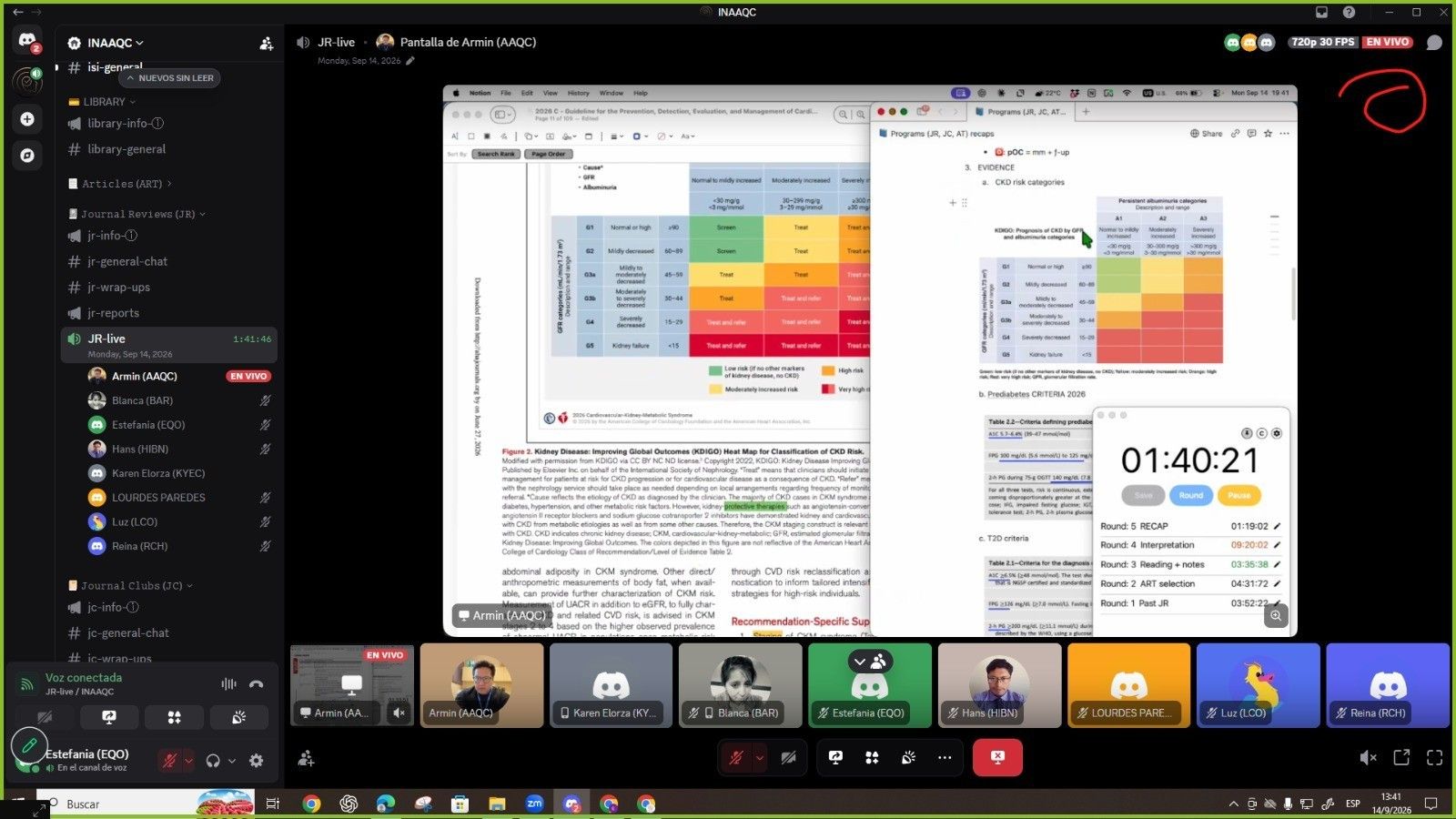
2026 NEJMc - A New Guideline on Cardiovascular–Kidney–Metabolic Syndrome (AHA).pdf
Codified by 𝙄𝙉𝘼𝘼𝙌𝘾 ᴮᴼ (LCO)
Glossary: ACC = American College of Cardiology, ADA = American Diabetes Association, AHA = American Heart Association, ASN = American Society of Nephrology, CKD = chronic kidney disease, CKM = cardiovascular-kidney-metabolic syndrome, CVD = cardiovascular disease, HF = heart failure, T2D = type 2 diabetes
1. 𝙄𝙌𝘾 𝙨𝙘𝙤𝙥𝙚 ▶︎ Y, J, C ➖ T ➕ N ➕ t ➖ P I C O:
2. 2026, CIRCULATION, USA 🇺🇸 ➖ GL ➕ NA ➕ ❓ ➖ P I C O:
3. EVIDENCE.
a. CKD risk categories (KDIGO)
b. Prediabetes CRITERIA 2026 (ADA)
c. T2D criteria (ADA)
d. CKD definition - KDIGO 2021
4. METHODS.
- Obesity 🧸
- T2D 🍫
- CKD ♾️
- CVD 🫀
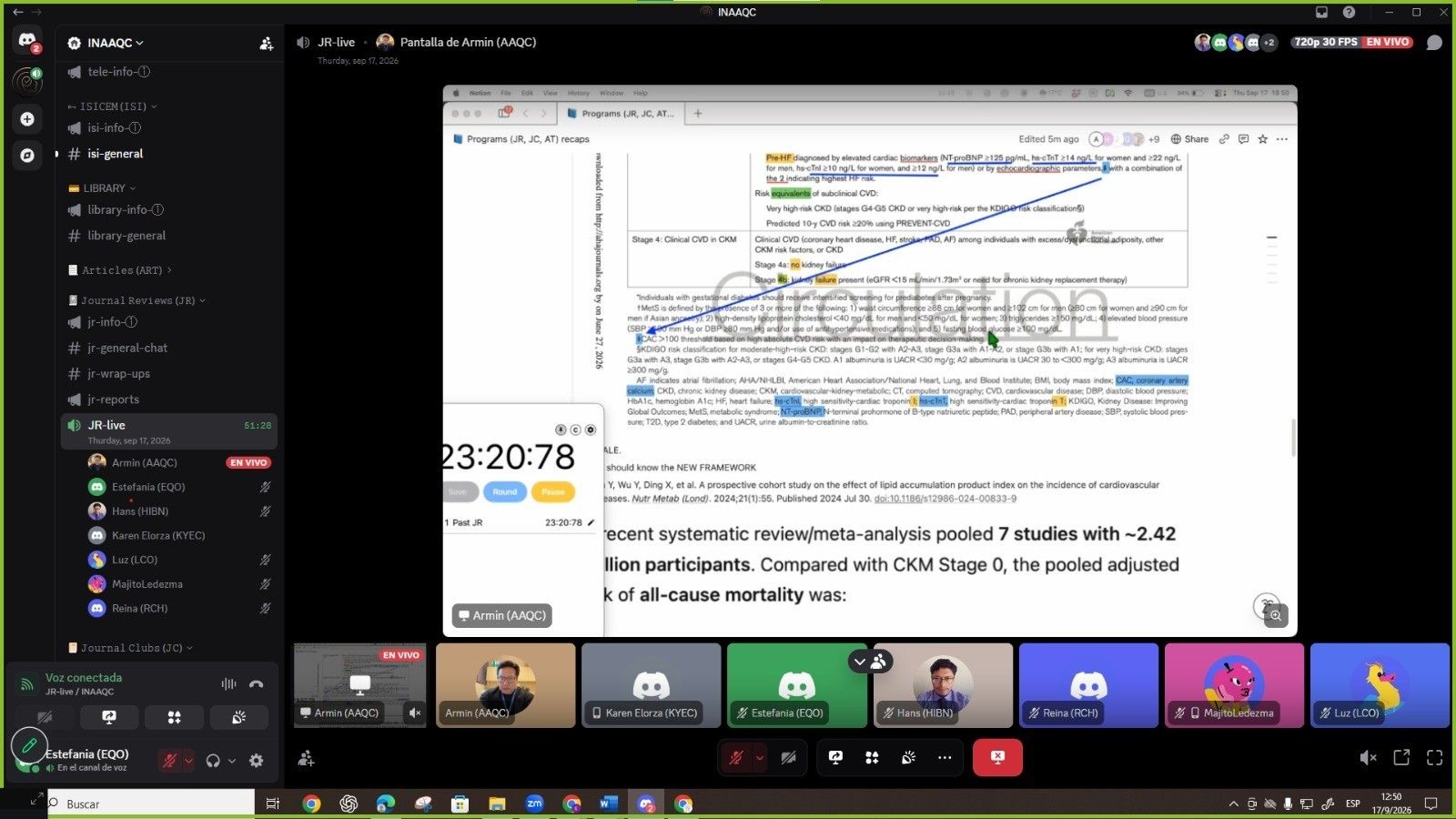
5. RESULTS.
a. 4 stages
i. 1. overweight ⌄ obesity ⌄ prediabetes
ii. 2. HTA ⌄ T2D ⌄ mod-hr_CKD
iii. 3. subclinical CVD (calcifications ⌄ pre-HF) ⌄ ≥20% (r_10y of CVD) PREVENT calculator ⌄ hr_CKD
iv. 4. Clinical CVD w_CKM conditions
b. PREVENT → 10-30y r_ASCVD, total CVD, HF
c. Monitoring:
i. 2-3y, S1:
1. lipids
2. glycemia
3. eGFR
ii. 1y, other S:
iii. UACR → 1y at ≥S2
⏳ TIME MANAGEMENT
02:27:28
Round: 6 00:55:42 Comments
Round: 5 02:05:13 RECAP
Round: 4 09:20:02 Interpretation
Round: 3 03:35:38 Reading + notes
Round: 2 04:31:72 ART selectionRound: 1 03:52:22 Past JR
d. Overweight + obesity → CONSIDERED root cause of CKM
i. AGGRESIVE lifesyle modification
ii. pharmacologic TTO (selected pxs)
6. RATIONALE.
a. We should know the NEW FRAMEWORK
b. Tan Y, Wu Y, Ding X, et al. A prospective cohort study on the
c. Li N, Li Y, Cui L, et al. Association between different stages of cardiovascular-kidney-metabolic syndrome and the risk of all-cause mortality. Atherosclerosis. 2024;397:118585. doi:10.1016/j.atherosclerosis.2024.118585
d. Li J, Wei X. Association of cardiovascular-kidney-metabolic syndrome with all-cause and cardiovascular mortality: A prospective cohort study. Am J Prev Cardiol. 2025;22:100985. Published 2025 Mar 29. doi:10.1016/j.ajpc.2025.100985
7. SOURCE ▶︎ Ndumele CE, et al. AHA/ACC/ADA/ASN guideline for the prevention, detection, evaluation, and management of cardiovascular–kidney–metabolic syndrome: A report of the American College of Cardiology/American Heart Association Joint Committee on Clinical Practice Guidelines. Circulation 2026 Jun 9; 2026; [e-pub]. DOI: 10.1161/CIR.0000000000001453. PubMed
2026 NEJMc - Acute Coronary Syndromes in Premenopausal ♀ (C).pdf
Codified by KYEC
ACS = acute coronary syndrome, DAPT = dual antiplatelet therapy, ID = identify, MECHs = mechanisms, MINOCA = myocardial infarction with nonobstructive coronary arteries, mm = management, PCI = percutaneous coronary intervention, rf = risk factor(s), SAP = systolic arterial pressure, SCAD = spontaneous coronary artery dissection, TTO = treatment(s)
1. 𝙄𝙌𝘾 𝙨𝙘𝙤𝙥𝙚 ▶︎ 2026, CIRCULATION, USA 🇺🇸 ➖ GL ➕ NA ➕ NA ➖ P I C O:
2. EVIDENCE.
a. ACS → distinct + understuded + w_unique etiologieS
b. Nonobstructive + nonatherosclerotic causes:
i. ↑ :♀ premenopausal + ♀-specific factors (🤰🏻 + hormonal influences)
ii. ↓ : older population
c. DIFF → DX challenges + TTO uncertainty + underrepresentation in clinical trial.
d. mm ➩
i. cause-specific TTO
ii. 🤓 ♀-specific risks
iii. more-agressive lifetime prevention
3. GL ★ 🗣
i. SCAD
ii. MINOCA
iii. LESS COMMON: Atherosclerosis
Monday, September 21, 2026 at 18:15:29 CEST
EQO, BKN, C, KYEC, LP, HIBN, AAQC
⏳ TIME MANAGEMENT
01:16:01
Round: 7 02:03:27 Comments
Round: 6 28:58:36 RECAP
Round: 5 14:39:15 Interpretation
Round: 4 11:00:40 Reading + notes
Round: 3 04:51:69 ART selection
Round: 2 00:39:52 Comments
Round: 1 13:49:41 Past JR
i. Could miss → SCAD + plaque erosion
ii. So → do INTRACORONARY imaging + multimodality imaging.
i. Standard GL-directed medical TTO ✔︎ → young♀
ii. For SCAD
1. PCI ✖︎
2. DAPT ✖︎
3. Conservative ✔︎
iii. DAPT
1. PCI
2. plaque disruption
3. ✖︎ : SCAD ⌄ vasospastic MECHS
iv. B-blockers
1. MINOCA to prevents recurrence.
i. Aggressive. Why? long lifetime risk in premenopausal ♀
ii. LDL → <55-70
iii. SAP → <120, if tolerated
iv. ♀-specific rf:
4. RATIONALE.
a. Not simply a “early atherosclerosis”
b. Earlier + more-aggresive LIFETIME risk ↓
c. Evidence gaps (mm largely empirical):
i. SCAD
ii. MINOCA
d. “noncardiac chest pain” → ID properly
5. SOURCE ▶︎ Kovacic JC, et al. Acute coronary syndromes in premenopausal women: A scientific statement from the American Heart Association. Circulation 2026 Feb 17; 153:e89. DOI: 10.1161/CIR.0000000000001416.
Codified by KYEC
abs = absolute, ATC = Anatomical Therapeutic Chemical, popul = population, REG = registries, SJS = Stevens-Johnson Syndrome, TEN = Toxic Epidermal Necrolysis
1. 𝙄𝙌𝘾 𝙨𝙘𝙤𝙥𝙚 ▶︎ 2026, NEUROLOGY, DA 🇩🇰 ➖ cohort_popul-based REG (1. National Prescription, 2. Patient Register, 3. Civil Registration System)➕ 1,4M ➕ 1995-2024 (29y) ➖ P I C O:
2. EVIDENCE.
a. SJS/TEN → serious cutaneous Æ ↔ several ANTISEIZURE MEDS: lamotrigine ➕ carbamazepine
3. METHODS.
4. RESULTS.
a. 55yo [40-70]
b. ♀ 56%
c. 90d af_initiation
i. 83 (1st weeks)
d. 1y MM
i. 1,4M = 17%
ii. 83 cases = 7%
e. ↑ abs_r (cases per 100k initiators)
i. lamotrigine (29)
ii. carbamazepine (16)
iii. phenobarbital (15)
iv. oxcarbazepine (11)
v. valproic acid (7)
f. ↓ r_
i. ↓ r_
ii. gabapentina (1,2)
Thursday, September 24, 2026 at 18:35:57
EQO, MLLD, LCO, RCH, JQB, KYEC, LP, BAR, HIBN, AAQC
⏳ TIME MANAGEMENT
01:11:46
Round: 8 01:12:58 Comments
Round: 7 28:22:23 RECAP
Round: 6 06:57:24 METHODS
Round: 5 15:52:33 Interpretation
Round: 4 04:45:06 Reading + notes
Round: 3 00:02:76 Lapsus
Round: 2 05:55:18 ART selectionRound: 1 08:38:76 Past JR
g. Newer antiseizure MED
i. NO SJS/TEN
h. 90d background_r (cases per 100k individuals)
i. general population (0.17)
i. PD ▶︎ ↑ connectivity:
i. SCAN ↔ subcortical structures
ii. ↑ ↑ ↑ hyperconnectivity ≈ WORSE motor ➕ cognitive impairment.
5. RATIONALE.
a. This data updates and extend older evidence
b. Provide a contemporary reference for SJS/TEN_r in antiseizure MED (including newer agents)
6. SOURCE ▶︎ Heerfordt IM, Mogensen M, Horwitz A, et al. Risk of Stevens-Johnson Syndrome and Toxic Epidermal Necrolysis After Initiation of Antiseizure Medication: A Danish Nationwide Cohort Study. Neurology. 2026;107(3):e218355. doi:10.1212/WNL.0000000000218355